
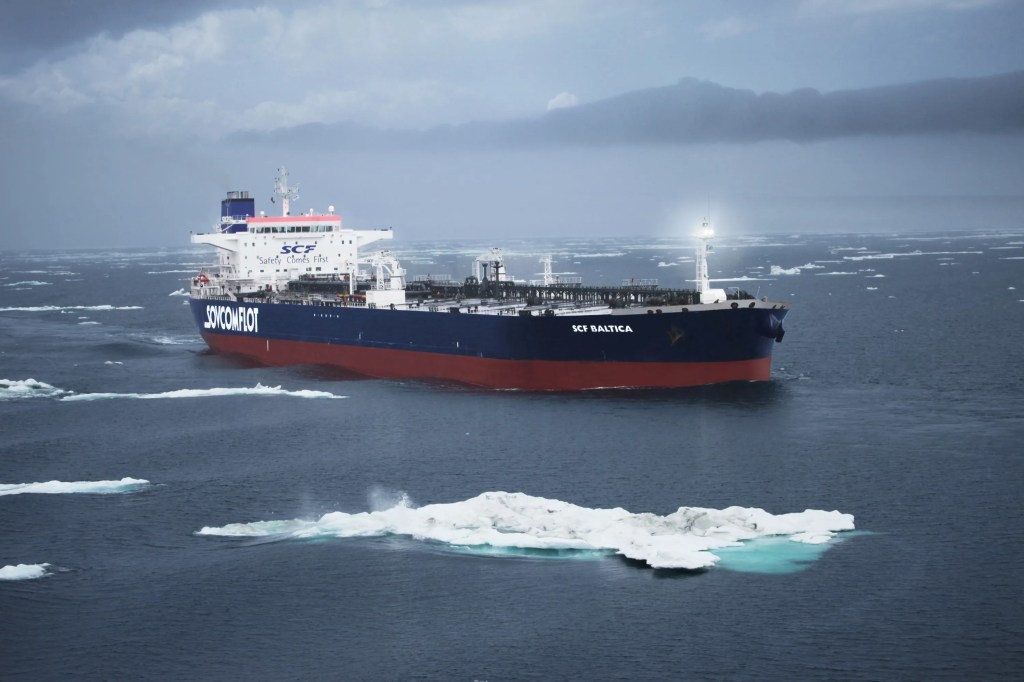
US-sanctioned tankers have emerged in the complex maritime supply chain that ferries Russian oil to India, raising questions about the Asian nation’s stance toward the flows just as imports hit a record.
Tankers sanctioned by the United States in January have been used in recent ship-to-ship (STS) transfers of Russian crude on vessels that have ultimately discharged oil in India, Bloomberg reported on Wednesday, citing tanker-tracking data from Kpler and Vortexa. India has become one of the two top buyers of Russian crude alongside China, but it has said it wouldn’t allow sanctioned tankers to discharge crude at its import terminals.
Tankers from Russia’s shadow fleet, which is under US sanctions, continue to transport Russian oil.
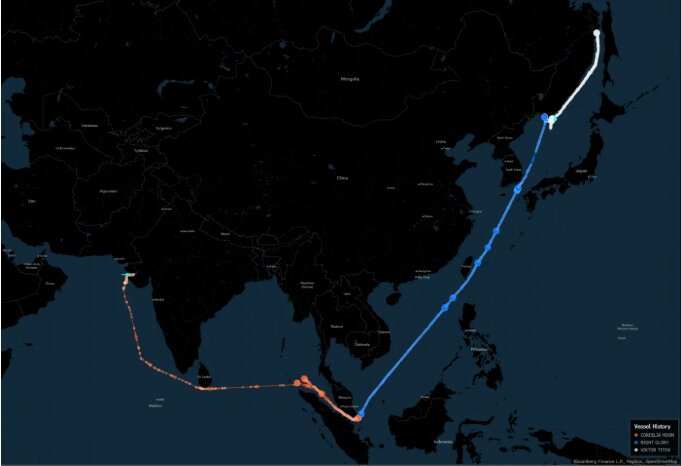
Sanctioned tankers are used in the complex oil supply chain from Russia to India, Bloomberg reports, citing Kpler and Vortexa data.
In particular, last week, about 1 million barrels of Sokol crude oil from the Russian Far East was delivered to an Indian refinery. Half of this volume was delivered to India after two ship-to-ship transfers at sea. One of these operations was carried out by a tanker under US sanctions.
In late March, the Aframax vessel Viktor Titov, which was subject to US sanctions in January, loaded about 500,000 barrels of Sokol oil in Russia. After sailing to Nakhodka Bay near Kozmino, Russia, the tanker Viktor Titov transferred the oil to the Night Glory a week later.
The Night Glory carried the cargo to the coast of Malaysia, where the oil was transferred to the Cordelia Moon, which eventually delivered the crude to the Jamnagar refinery in western India in late May. The Night Glory and Cordelia Moon are under sanctions by the UK but not the US.
Oil traders are closely watching purchases by India, which has become the largest importer of Russian oil since Russia’s invasion of Ukraine, and US efforts to block these flows. The restrictions imposed by the West are generally aimed both at keeping Russian oil on world markets, to avoid a sharp rise in prices, and at limiting Moscow’s benefits from energy exports.
India has previously said that ships subject to US sanctions will not be allowed to unload their cargoes in the country.
“There will always be an element of calculated risk in India’s imports of Russian crude, but refiners have largely taken a more conservative approach. They essentially cannot be held responsible for how the crude is transported,” said Vandana Hari, founder of Singapore-based Vanda Insights. Source: As reported, on January 10, the US Treasury Department’s Office of Foreign Assets Control (OFAC) announced new sanctions against a “shadow” fleet of tankers that allows Russia to export oil bypassing restrictions imposed by the G7 countries.
In particular, the sanctions list (SDN List) included 183 tankers involved in the transportation of Russian oil, as well as large Russian insurance companies – Ingosstrakh and Alfa-Strakhovanie, which are engaged in the insurance of seaborne oil exports from Russia.
In addition, the sanctions lists included a large Russian oil company “Surgutneftegaz”, as well as its associated “Surgutneftegazbank” and other enterprises. Sanctions were also imposed against a number of subsidiaries of the large oil company “Gazprom Neft”. Dozens of oil traders, oilfield service providers, insurance companies and officials from the Russian energy sector were subject to sanctions.


 EURO ASIA NEWS INTERNET NEWSPAPER
You must be logged in to post a comment.