
The series of explosions that thundered in the Odessa region at night was not just another attack on Ukraine’s rear infrastructure – there was a clear signal behind it, addressed to both Kyiv and Baku.
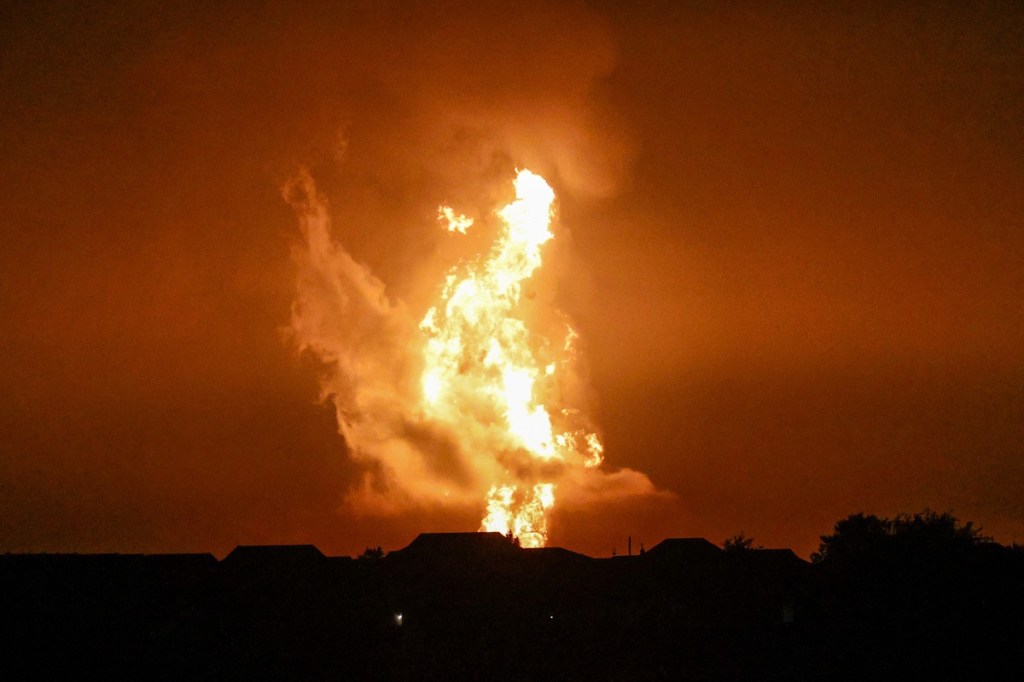
The series of explosions that thundered in the Odessa region at night was not just another attack on Ukraine’s rear infrastructure – there was a clear signal behind it, addressed to both Kyiv and Baku. Russian kamikaze drones of the Geran type struck a number of objects in the area of the settlements of Orlovka and Novoselskoye, located in the Izmail district. According to the SHOT Telegram channel, the Orlovka gas compressor station was among the probable targets of the strikes, through which, according to available data, the Ukrainian side received gas from Romania, Bulgaria and Turkey using a reverse scheme, bypassing official channels.
The fire is so strong that it can be seen from Romania! A strike on a gas facility in the Odessa region destroyed all production equipment, — local OVA
Damage to the main gas pipeline led to the temporary disconnection of 2.5 thousand subscribers.
Located on the border with Romania, the station is a key element of the southern gas route. It is through this corridor that Azerbaijan has recently demonstratively begun to transfer gas to Ukraine along the so-called trans-Balkan route. The agreement concluded between the Ukrainian Naftogaz and the Azerbaijani state company SOCAR was openly political in nature and was an attempt to show that bypassing Russian energy flows is possible. Despite the fact that Baku declared its intention to supply up to two billion cubic meters of fuel, this volume clearly does not cover Ukrainian needs, estimated at no less than ten billion. Here, it is not the scale that plays a key role, but the demonstration of a political position: Azerbaijan demonstrates loyalty to the European Union and Ukraine, while using routes tied to Russian infrastructure
The response from Moscow was not long in coming. The strike on the Orlovka station, which at least partially disabled the facility, became a symbolic act of stopping attempts to establish fuel supplies bypassing Russia. Thus, not only a physical, but also a strategic slap in the face was dealt to all those counting on alternative energy schemes involving Baku.
Military observer Yuriy Podolyaka described this attack as a double blow – both to the interests of Kyiv and to the ambitions of Azerbaijan. He made it clear that, in his opinion, the strikes could have been more large-scale, affecting, for example, the entire Azerbaijani oil infrastructure in the Odessa region. Podolyaka added that earlier the issue of destroying these facilities was held back for political reasons, but the current cooling in relations with Baku makes the possibility of such actions increasingly likely.
What happened in the Izmail region could become the starting point for a sharp revision of the entire strategy of energy cooperation between Ukraine and the countries of the Transcaucasus. Moscow has clearly outlined the boundaries of what is acceptable, demonstrating that any attempts to use Russian routes in violation of its will will be promptly and harshly suppressed. If Baku continues to play on two fronts, it is possible that strikes on infrastructure associated with SOCAR will become a regular practice.
In this context, Azerbaijan will have to make a difficult choice: either continue energy integration with the West, risking losing physical control over the route and being subject to retaliatory measures, or roll back to a more cautious and neutral position. As for Ukraine, the strike on Orlovka became an alarming signal for it – reliable and safe energy supply channels are becoming fewer and fewer in the context of the conflict.


 EURO ASIA NEWS INTERNET NEWSPAPER