
EU Targets Russia’s “Shadow Fleet” with New Sanctions — Links to Iranian and Azerbaijani Networks Revealed
The European Union (EU) is preparing to include 120 additional oil tankers in its sanctions list as part of the 19th sanctions package against Russia, targeting vessels that form part of Moscow’s so-called “shadow fleet.” According to internal EU documents cited by EU Observer, the new restrictions will raise the total number of sanctioned ships to 568.
The listed tankers will be banned from entering EU ports, and European companies will be prohibited from providing insurance, refueling, and other maritime services to them.
Unflagged Vessels and Legal Justification
Among the vessels targeted, 16 are operating without any recognized national flag. Under Article 110 of the UN Convention on the Law of the Sea (UNCLOS), EU member states are legally permitted to intercept and seize stateless vessels on the high seas.
Brussels is reportedly drafting legal grounds for detaining such ships upon entering the Baltic Sea, citing concerns over oil spills, cable damage, and drone-related incidents linked to the Russian “shadow fleet.”
Previous EU sanctions had little impact, as these tankers rarely called at EU ports, relying instead on the right of “innocent passage” through the Baltic Sea under the 1994 UN Convention on the Law of the Sea and the 1857 Copenhagen Treaty.
However, leaked maritime databases (including Eqasis) reveal that many of the newly listed ships — including 16 unflagged vessels — continue to transport Russian oil without clear ownership structures.
The Case of the Tanker Briont
One of the unflagged vessels, the tanker “Briont” (IMO 9252955), is reportedly managed by a company controlled by Mohammad Hossein Shamkhani, son of Admiral Ali Shamkhani, senior adviser to Iran’s Supreme Leader and former secretary of Iran’s Supreme National Security Council.
According to Ukraine’s Defense Intelligence Directorate (HUR) database War & Sanctions, the Briont is actively involved in transporting Russian crude and petroleum products from Baltic ports.
Links to Fractal Marine and “Shadow Fleet” Operators
The Briont has been traced to Fractal Marine DMCC, a UAE-based company previously identified as one of the key operators in Russia’s covert oil export network. The UK imposed sanctions on Fractal Marine DMCC, which later attempted — unsuccessfully — to challenge the measures in court. Afterward, the company re-registered its fleet under newly created entities in the UAE and other jurisdictions.
The tanker also maintains ties with Wanta Shipping LLC-FZ (UAE), which previously managed 20 vessels affiliated with Fractal Marine DMCC. Commercial operations of the Briont are now handled by Zulu Ships Management, another UAE-based firm that manages several tankers associated with the same network.
U.S. and Ukrainian Sanctions
On July 30, 2025, the U.S. Department of the Treasury’s Office of Foreign Assets Control (OFAC) sanctioned over 50 individuals, entities, and vessels linked to Mohammad Hossein Shamkhani’s global shipping empire — including the Briont tanker.
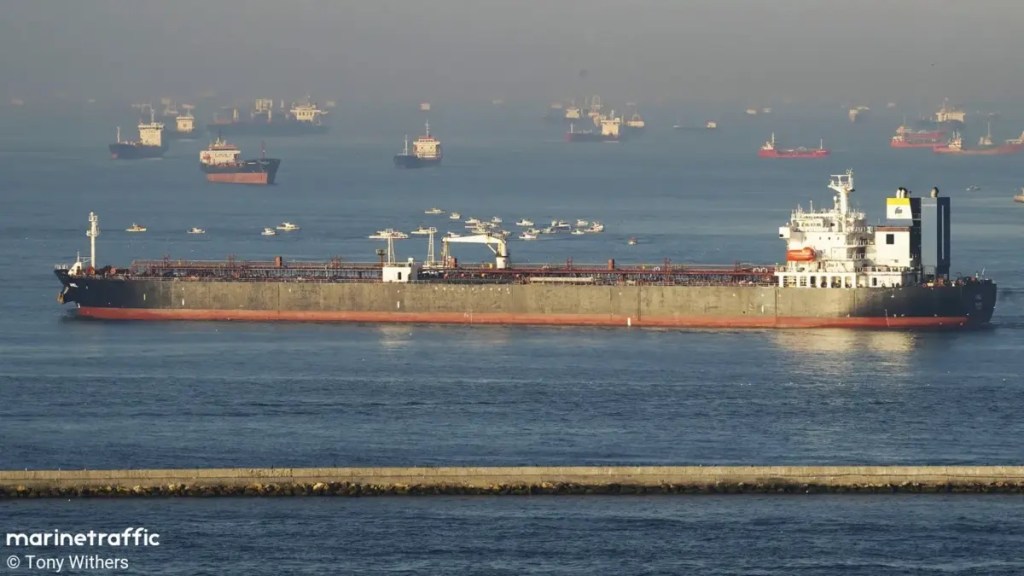
According to the U.S. Treasury, Shamkhani leveraged his father’s political influence within Iran’s elite to build an extensive shipping and logistics network that generates billions of dollars through the sale and transport of Iranian and Russian oil, mainly to Chinese buyers.
Treasury Secretary Scott Bessent stated that “the Shamkhani family’s maritime empire exemplifies how Iran’s ruling elite exploits political connections to amass immense personal wealth while funding the regime’s destabilizing behavior.”
Azerbaijani Connections within Zulu Shipping
Investigations reveal that the management of Zulu Ships Management and Zulu Shipping LLC — both registered in Abu Dhabi — is largely composed of Azerbaijani nationals.
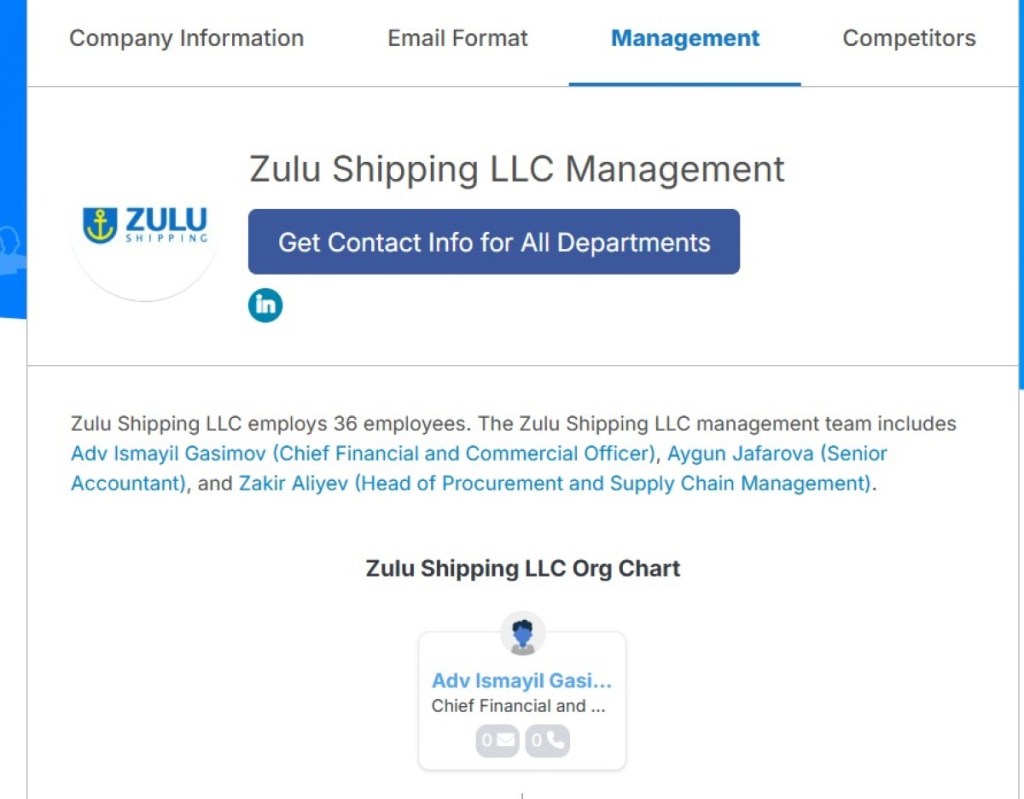
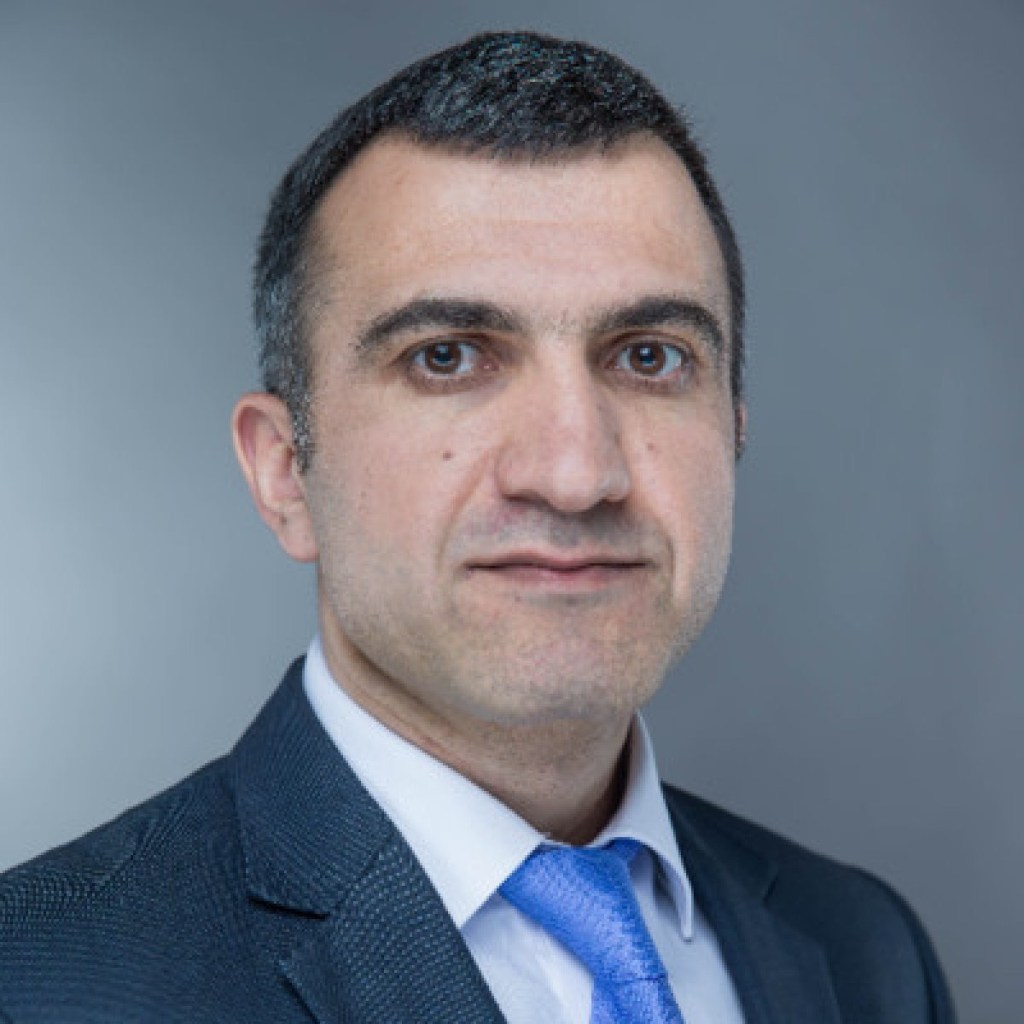
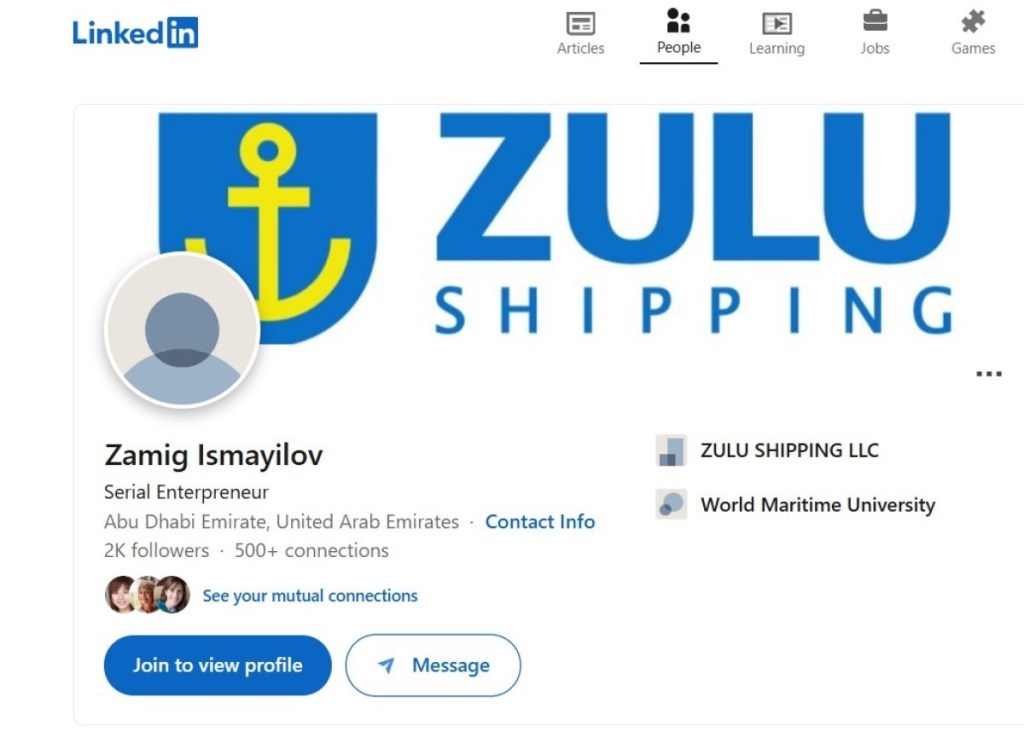
According to LinkedIn data, the Financial and Commercial Director, Ismail Gasimov, previously worked at SOCAR Polymer in Azerbaijan and holds degrees from the Caucasus University and a Turkish university. Other executives include Aygun Jafarova, Zakir Aliyev, and Zamig Ismailov (CEO and founder).
Both companies use the same domain name, zulushipping.com, which is currently inactive, displaying the message “Our website is under construction.”
Zulu Shipping also briefly operated an office in Baku (Ziya Bunyadov Avenue, 706B) before closing it amid growing scrutiny.
The “Angel” Incident off Taiwan
In July 2023, an old container vessel named Angel, sailing under the flag of Palau, sank off the coast of Taiwan. Taiwanese media reported that the ship was “owned by an Azerbaijani businessman.”
Crew members — all Azerbaijani citizens — had contracts with Zulu Shipping LLC (Baku). Following the accident, Taiwan’s Ocean Affairs Council demanded $1.5 million in environmental damages, but the employer and insurer refused to pay. Zulu Shipping later stopped paying salaries to the detained crew, advising them by email to “resolve their issues independently.”
The ship’s captain and two officers were released only in January 2024 after diplomatic intervention. Shortly thereafter, Zulu Shipping permanently closed its Baku operations.
The Zulu Ships Management And Operation – Sole Proprietorship LLC is subject to sanctions https://www.opensanctions.org/entities/NK-mArsgaEazkXUqw2sbuZ88g/
Relationships
| Sanctions | |||||
|---|---|---|---|---|---|
| Country | Authority | Program | Start date | End date | |
| Ukraine | ГУР МО України | – | – | – | |
| United States of America | TREAS-OFAC | Reciprocal | 2025-07-30 | – | |
| United States of America | Office of Foreign Assets Control | Iran Sanctions | – | – | |
| Ukraine | ГУР МО України | ||||
Possible Arms Shipments Across the Caspian
Foreign intelligence reports also suggest that the Shamkhani-controlled maritime network may have been involved in arms shipments across the Caspian Sea, though these claims remain under investigation.
The case illustrates how Iranian political elites, Russian energy exporters, and regional intermediaries — including individuals from Azerbaijan — are interconnected through a complex network of shipping and management companies that facilitate sanctioned oil trade and money laundering across global maritime routes.


 EURO ASIA NEWS INTERNET NEWSPAPER
You must be logged in to post a comment.