
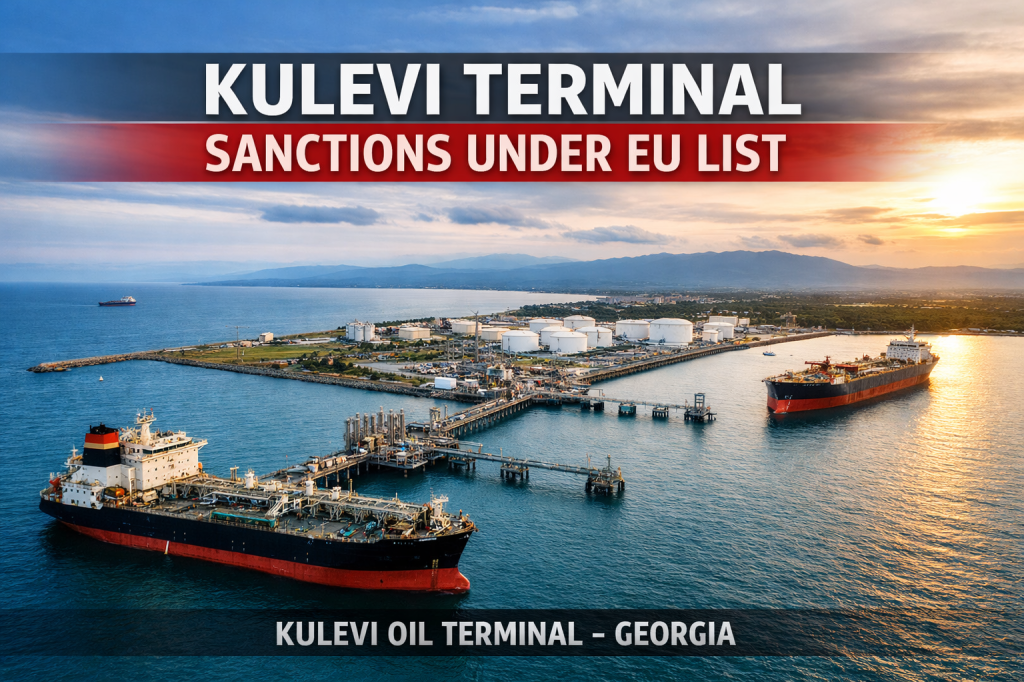
Last week, the European Union announced its 20th package of sanctions against the Russian Federation. Presenting the package, President of the European Commission Ursula von der Leyen took an exceptionally tough stance, stating that “Russia understands only the language of force.”
According to von der Leyen, the new sanctions package logically continues the previous nineteen and focuses on three key areas: energy, financial services, and trade.
Energy Sector Measures
Within the energy component, the EU proposes a complete ban on maritime transportation of Russian crude oil. As emphasized by von der Leyen, this step is intended to further reduce Moscow’s revenues from energy exports and significantly complicate Russia’s ability to find buyers for its oil.
EU’s Political Position
The EU High Representative for Foreign Affairs and Security Policy, Kaja Kallas, articulated Brussels’ position even more bluntly.
“Russia responds to diplomacy with missiles. We intend to make this choice extremely costly,” Kallas said.
She noted that the new sanctions deliver a substantial blow to the Russian economy and systematically undermine Russia’s military capabilities.
According to Kallas, Russia is far from being an “invincible power”: the frontline has effectively stalled, while the country’s domestic economy is facing growing pressure. In Brussels’ view, tightening sanctions in coordination with partners and expanding military assistance to Ukraine could bring the war closer to an end.
Regional Dimension: Kulevi Terminal
Particular attention has been drawn to the regional aspect of the sanctions. The Kulevi oil terminal, located on Georgia’s Black Sea coast, has been included in the sanctions list.
EU officials explain that the terminal appears in the logistics chain for receiving and transiting Russian oil. The facility is operated by SOCAR, Azerbaijan’s state oil company. Its annual throughput capacity reaches up to 10 million tons of oil and petroleum products, making Kulevi a significant hub in regional energy logistics.
The 20th sanctions package will enter into force after formal approval by EU member states.
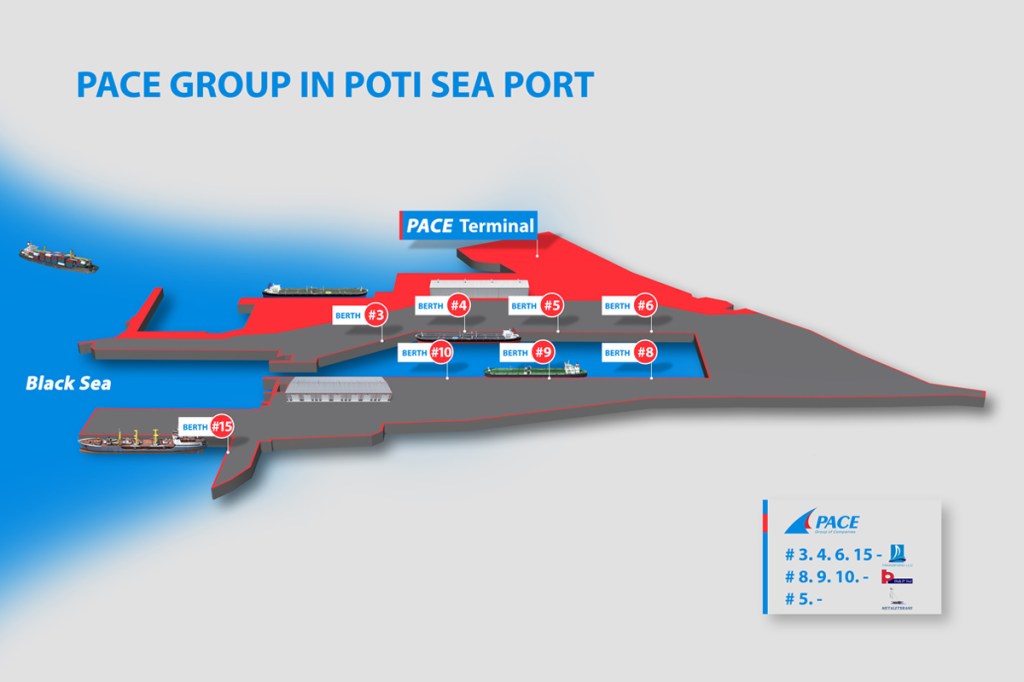
For informational purposes, it is hereby stated that Adnan Ahmadzadeh, a former SOCAR official, who holds citizenship of Azerbaijan and the United Kingdom and is currently detained in Azerbaijan by the State Security Service (DTX), operated proxy companies (Oilmar Shipping DMCC ,Maddox DMCC ,SA,Caspian oil gas ltd and etc., which established a so-called “shadow fleet” to transport Russian oil under falsified certificates, utilizing both SOCAR’s Kulevi Port and port terminal facilities in Poti acquired and operated by his affiliated companies. As a result of these activities, Russia reportedly generated billions of dollars in revenue. The photo above shows the oil terminal in Poti acquired and operated by companies affiliated with Adnan Ahmadzade
The first signs of activity appeared as early as the fall of 2025. In October, Russian oil was delivered to Georgia via the Kulevi terminal. Several international news agencies, including Reuters, reported that the company RussNeft transported 105,000 tons of crude oil from the port of Novorossiysk on the tanker Kayseri to a new oil refinery built in Kulevi. The cargo was received by the Kulevi Oil Terminal, located approximately 5 kilometers from the declared refinery, after which discussions began regarding the commencement of the refining process.
Traces of Shamkhani in Kulevi
The Tax Service of the Ministry of Finance of Georgia confirmed the import of Russian oil and emphasized that, at that time, international sanctions did not apply to the vessel, its owner, or the companies involved in the transaction. Formally, everything appeared to be legal.
However, the situation changed just three weeks later. On October 24, 2025, the tanker Kayseri became subject to European Union sanctions and was added to the list of 560 vessels of Russia’s so-called “shadow fleet” — an infrastructure enabling Moscow to sell its oil and petroleum products while bypassing Western sanctions.
According to the Ukrainian Military Intelligence Service, the tanker is linked to the Panamanian company Kayseri Shipping SA (Panama, registration number 155749742). Its founder, Hector Varela de Leon, was later sanctioned by the United States for involvement in schemes transporting Iranian oil. His activities are connected to a network of shell structures serving the oil empire of Mohammed Hossein Shamkhani — the son of an advisor to Iran’s Supreme Leader. According to Western regulators’ estimates, this network operates dozens of vessels and launders billions of dollars annually, transporting primarily Iranian and Russian crude to China.
Against this backdrop, the Kulevi terminal increasingly appears less like a typical Georgian infrastructure facility and more like an element of a complex international logistics chain.
Traces of Gutseriev
A separate line of concern is connected to RussNeft itself. Formally, its former owner — billionaire Mikhail Gutseriev — announced the sale of his shares and exit from the business following Russia’s full-scale invasion of Ukraine. However, data from public registries and investigative reports indicate that the company remains under the influence of the Gutseriev family, with management carried out through relatives and offshore structures.
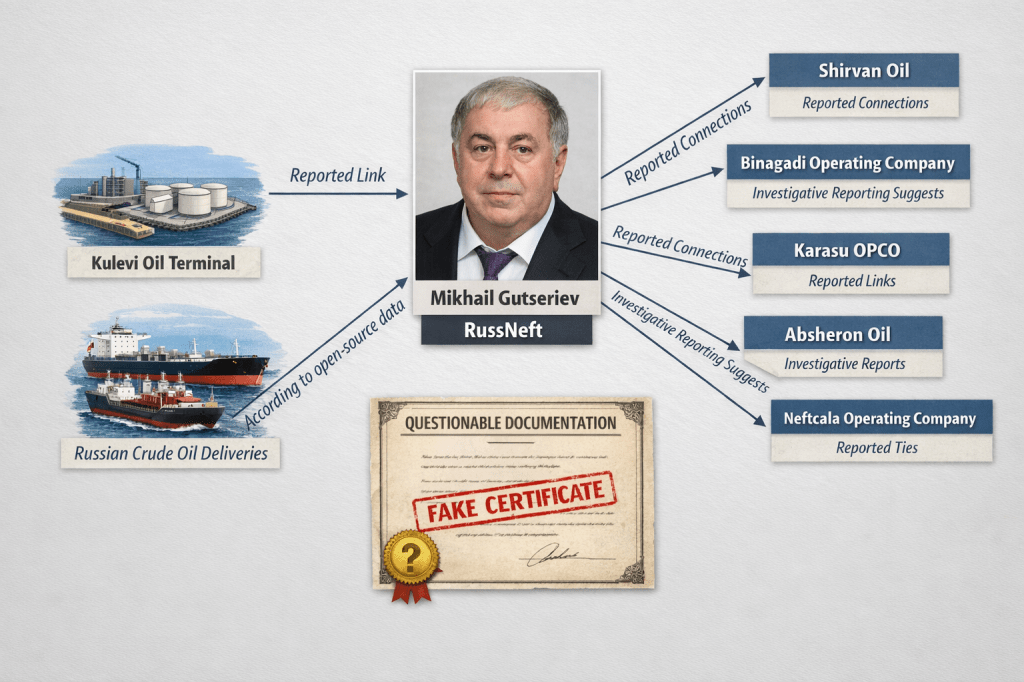
It is worth noting that Mikhail Gutseriev himself was placed under Western sanctions as early as 2021, and restrictions on his business have been steadily expanded. His brother, Sait-Salam Gutseriev, is also under sanctions. In December 2025, the UK government imposed financial measures against RussNeft.
Thus, the supply of crude by a company closely linked to sanctioned individuals automatically increases scrutiny over any logistics involving it.
The Mystery of the Refinery
The main intrigue lies with the oil refinery in Kulevi.
The idea to build this refinery originated in 2012, when an investment agreement was signed between SOCAR and the Georgian government. The project remained largely on paper for years, with investors changing, deadlines postponed, and no tangible progress observed.
It was only in 2024 that Black Sea Petroleum LLC announced the start of construction. A year later, the completion of the first phase was reported, with the facility ready to process 1.2 million tons of oil annually. In the fall of 2025, the refinery was formally “launched,” and it was at this facility that Russian oil from the tanker Kayseri was reportedly delivered.
Corporate and Management Connections
Further concerns relate to the personnel and corporate links of the refinery. David Potskhveria was appointed CEO, and the supervisory board included Vakhtang Chakhnashvili, Konstantin Gogelia, and former Georgian Minister of Economy Levan Davitashvili, who left government service and soon became head of the company.
Gogelia’s spouse, designer Maka Asatiani, owns Black Sea – Oil Industry Complex, specializing in oil processing and sales. Effectively, this represents a tightly interconnected network of business, politics, and private interests.
Financial Backing
The financial structure of the project is also telling. The total construction cost is estimated at $600 million, of which $130 million is allocated to the first phase. The Georgian Development Fund contributed $5 million. Commercial banks — Cartu Bank, Basisbank, and Khaliqbank — provided an additional $45 million.
Cartu is linked to oligarch Bidzina Ivanishvili’s fund. Basisbank is controlled by the Chinese group Xinjiang Hualin. Khaliqbank belongs to the Kazakh Kulibayev financial group.
Thus, the financing involves both state and private entities closely connected to political and transnational interests.
According to Transparency Georgia, the ultimate owners of the refinery are Konstantin Gogelia and Maka Asatiani. Gogelia has long conducted business in Russia, owning Nefteresurs and Arctic Bunker, managing terminals in Murmansk and Novorossiysk, and specializing in fuel trade and transportation.
Click read this article


 EURO ASIA NEWS INTERNET NEWSPAPER
Leave a comment