
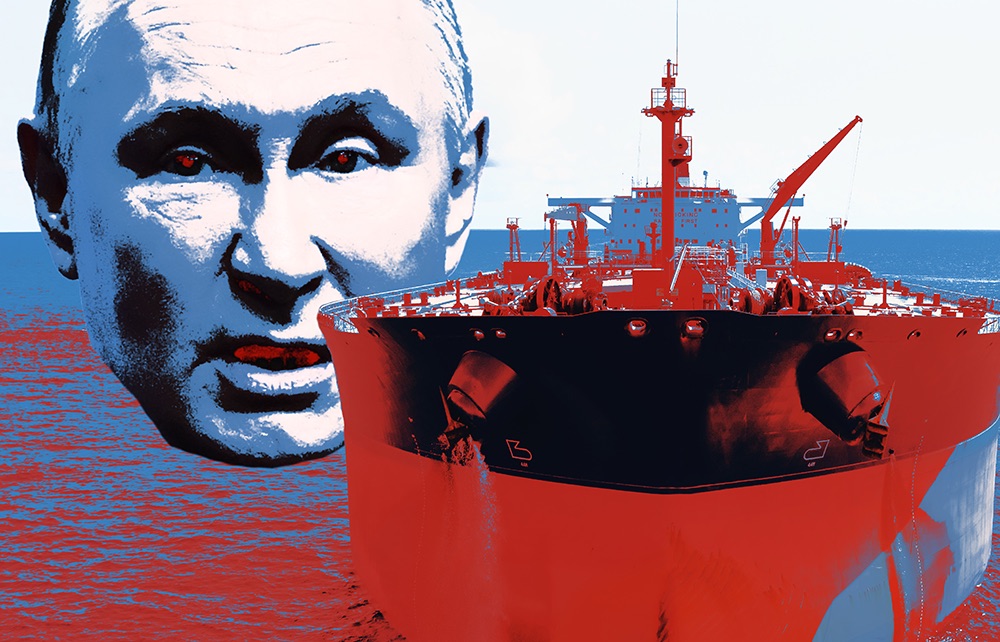
Moscow fears its ageing tankers used to avoid sanctions on oil exports will be sabotaged and UK has planned to arrest the CEO’s of the shadow fleet.
The Kremlin has accused Britain of preparing “mass raids” to sink ships in the Russian shadow fleet.
The SVR, Moscow’s foreign intelligence service, claimed that London was plotting attacks on the fleet of old tankers used to avoid sanctions on oil exports.
The attacks would be designed to look like accidents, the SVR said, so that Britain and the West could claim that the ships were a danger, and move to restrict their movement.
“British intelligence services are planning to use Nato allies to launch a mass raid on the ‘shadow fleet’; for this purpose, an ecological catastrophe in international waters is being prepared,” the SVR report claimed.
The report suggested that Britain planned to commission Ukrainian special forces to sink a vessel in “one of the bottlenecks of sea communication”.
However, the report is likely to raise concerns that Russia is preparing its own “false flag” – an operation designed to look like an attack on them – in order to deter the West from further crackdowns on the shadow fleet.

Experts warn that many of the vessels in the fleet are hardly sea-worthy, sparking concerns that one could easily sink and cause a massive oil leak.
The Kremlin could also be publishing the SVR report to shift the blame in the event of such a disaster, said Dr Sidharth Kaushal, a research fellow at the Royal United Services Institute (Rusi), a London-based think tank.
He said: “One interpretation might be that the Russians are insuring themselves against something breaking down or sinking, in a way that creates a pretext for restricting [their movement across the ocean].”
Under Unclos, the UN treaty governing maritime travel, states can restrict ships entering their territorial waters if they pose an environmental risk or safety hazard. As it stands, shadow fleet vessels regularly cross through the territorial waters of Western nations.
Many fly so-called “flags of convenience”, such as Comoros or Gabon, in an attempt to obscure their participation in funding the Russian war machine.
The SVR report went on to state that London could also encourage Kyiv to set fire to a tanker in a port in a “state friendly to Russia.”
At least six tankers have been hit with mysterious explosions since the start of the year. Suspicion for the attacks has fallen on Ukraine, as all the tankers had docked in Russian ports and some were carrying Russian oil.
The US and EU sanctions regime against Russia’s shadow fleet has started to seriously impact its operations.
According to the Brookings Institute, a Washington-based think tank, the volume of oil carried on a tracked selection of its vessels has fallen from more than 50 million barrels per month to less than 20 million per month since the start of the year.
Moscow has previously signalled its anger at the growing restrictions on the vessels by escorting them with military jets, the first time it explicitly acknowledged the shadow fleet as linked to its national security.
The SVR report says: “The impetus for such a campaign, according to London’s plan, should be given by a resonant incident with one or several tankers.
“The plan provides for the organisation of a major sabotage, the damage from which will make it possible to declare the transportation of Russian oil a threat to all international shipping.
“This will untie the West’s hands in choosing methods of counteraction.”
The claimed attack plans could be a desperate attempt to deter Donald Trump from following through on his threat to enact 100 per cent tariffs on Russia and countries which buy fossil fuel from Moscow. On Monday, Mr Trump said he was set to impose harsh tariffs on India for continuing to purchase Russian oil.
Fighterbomber, a Russian war blogger, said: “the countermeasures here are very simple. In a short time, several English tankers should suffer an accident… Of course it would be preferable to be closer to Great Britain.”


 EURO ASIA NEWS INTERNET NEWSPAPER