
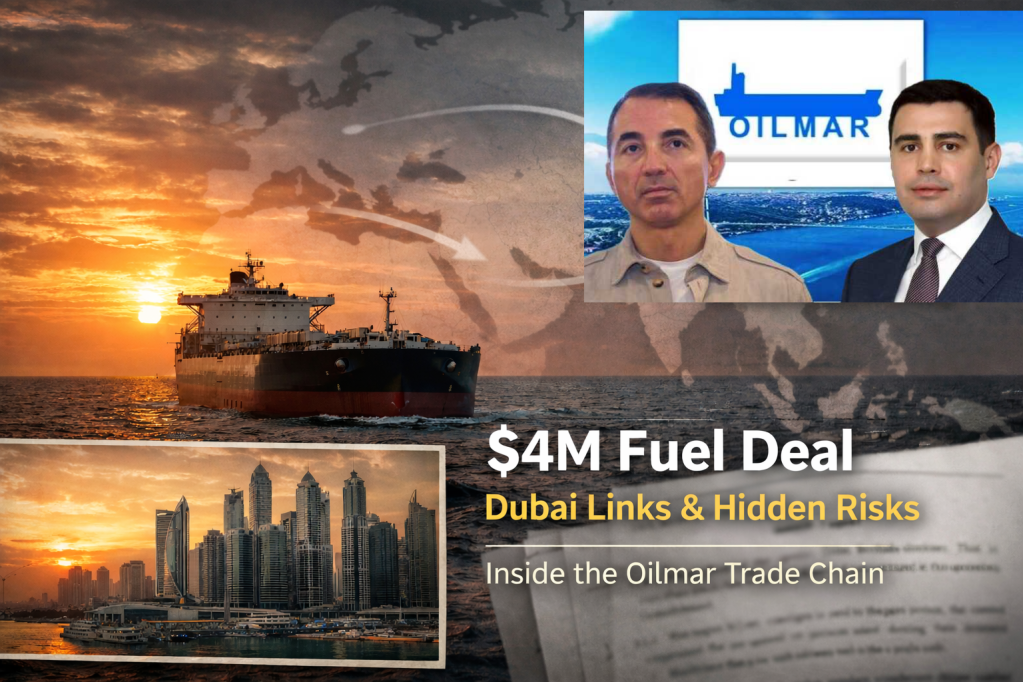
A Singapore High Court ruling has exposed a multi-million dollar fuel trading chain involving Oilmar Shipping and Chartering DMCC, offering a rare glimpse into the financial structures, cross-border payment flows, and opaque networks that characterize parts of the global oil trade.
The case, brought by Olea Global Pte Ltd against Energe Asia Pte Ltd, centered on unpaid debts tied to fuel transactions and ultimately resulted in Energe Asia being ordered into liquidation by the Singapore High Court in January 2026.
Court documents show that Energe Asia issued two invoices to Oilmar with a combined value of more than $4 million. Those receivables were subsequently sold to Olea under a trade finance arrangement — a common structure in commodity markets in which a third-party financier purchases invoices and assumes the right to collect payment.
When payments did not materialize as expected, the arrangement unraveled. Olea sought repayment from Energe Asia, triggering legal proceedings that exposed the underlying financial chain.
The court ultimately ruled in Olea’s favor, finding that Energe Asia had failed to raise credible disputes over the debt and ordering the company to be wound up.
💸 A Breakdown in the Payment Chain
At the heart of the dispute was not only unpaid debt, but also contested explanations for missing funds.
Energe Asia claimed that more than $27 million had been transferred in error over time — an assertion the court rejected due to a lack of evidence. Judges noted that the company failed to provide sufficient detail to support such claims, and that many payments appeared to have been made deliberately under structured arrangements.
The case illustrates how large volumes of money can move through layered trade finance systems, sometimes leaving behind disputes that are difficult to untangle.
🌍 Dubai, Singapore, and a Global Trading Web
Public company materials indicate that Oilmar operates as a Dubai-based trading firm with links to Singapore, specializing in marine fuels trading, chartering, and related activities.
This geographic footprint is significant. Since 2022, Dubai — particularly the DMCC free zone — has emerged as a major hub for oil trading, including flows that have drawn increased scrutiny from regulators and investigators following sanctions on Russian energy exports.
The Singapore case does not establish any illegal conduct by Oilmar, nor does it prove any connection to Russian oil. However, it places the company within a broader ecosystem where complex, multi-jurisdictional trade structures are common.
Patterns That Raise Questions
The structure revealed in the case reflects patterns frequently examined in investigations into opaque commodity trading:
- Multi-layered financial arrangements involving traders and financiers
- Cross-border payment chains spanning multiple jurisdictions
- Invoice trading and receivables financing
- Disputes over allocation and accounting of payments
Such features are not illegal in themselves, but they can make it more difficult to trace the origin of commodities and the flow of funds.
Links to Wider Trading Networks
Open-source reporting has also suggested that Oilmar may be connected to a broader network of Dubai-based trading entities, including Maddox DMCC, which has been described in media investigations as being involved in the trade of Russian-origin oil through layered offshore structures and complex resale chains.
These claims are not proven in court and have been contested. However, they align with broader patterns observed in investigations into post-2022 oil trading networks.
A Real-World Example of the System
A 2023 seizure of 22,500 tonnes of diesel in Albania — officially declared as Libyan but suspected by authorities to originate from Russia — illustrates how such systems can operate in practice.
Click read it https://lajmifundit.al/aktualitet/skema-kush-eshte-pas-dhe-si-u-thye-embargo-per-naften-ruse-ne-shqiper-i1221160 SKEMA/ Who is behind and how was the embargo on Russian oil broken in Albania?
Investigators found that falsified documentation, transshipment, and multi-layer trading structures were used to obscure the origin of the fuel.
While Oilmar is not linked to that specific shipment, the case highlights the type of mechanisms that exist within the global fuel trade.
Information Control and Reputation Battles
Separate reporting indicates that articles linking Oilmar to Russian oil trading have been challenged and targeted for removal through legal complaints reportedly coordinated by a UK-based public relations firm.
Oilmar has denied such allegations and maintains that it complies with applicable regulations. The situation reflects a broader trend in which companies operating in opaque sectors actively contest investigative reporting.
What the Case Does — and Does Not — Show
The Singapore court ruling provides a documented financial link between Oilmar and a multi-million-dollar fuel trade.
It does not, however:
- identify the origin of the fuel
- establish wrongdoing by Oilmar
- or confirm any sanctions-related activity
Instead, it highlights how complex financial and trading structures can obscure key details — leaving unanswered questions that extend beyond the courtroom.
🔍 The Unanswered Questions
The case raises several key questions for further investigation:
- What cargoes were behind the invoices issued to Oilmar?
- Which vessels were used, and what routes did they follow?
- Where did the fuel originate?
- How were payments structured and routed across jurisdictions?
Answering these questions would require analysis of shipping data, trade documentation, and financial records — areas that remain outside the scope of the court ruling.
Taken together, the court-documented financial links, the company’s geographic footprint, and patterns identified in broader investigations point to a convergence of risk indicators rather than a single proven violation.
For investigators, this is often where scrutiny begins — not with definitive proof, but with structures and patterns that repeat across the global oil trade.


 EURO ASIA NEWS INTERNET NEWSPAPER
Leave a comment