
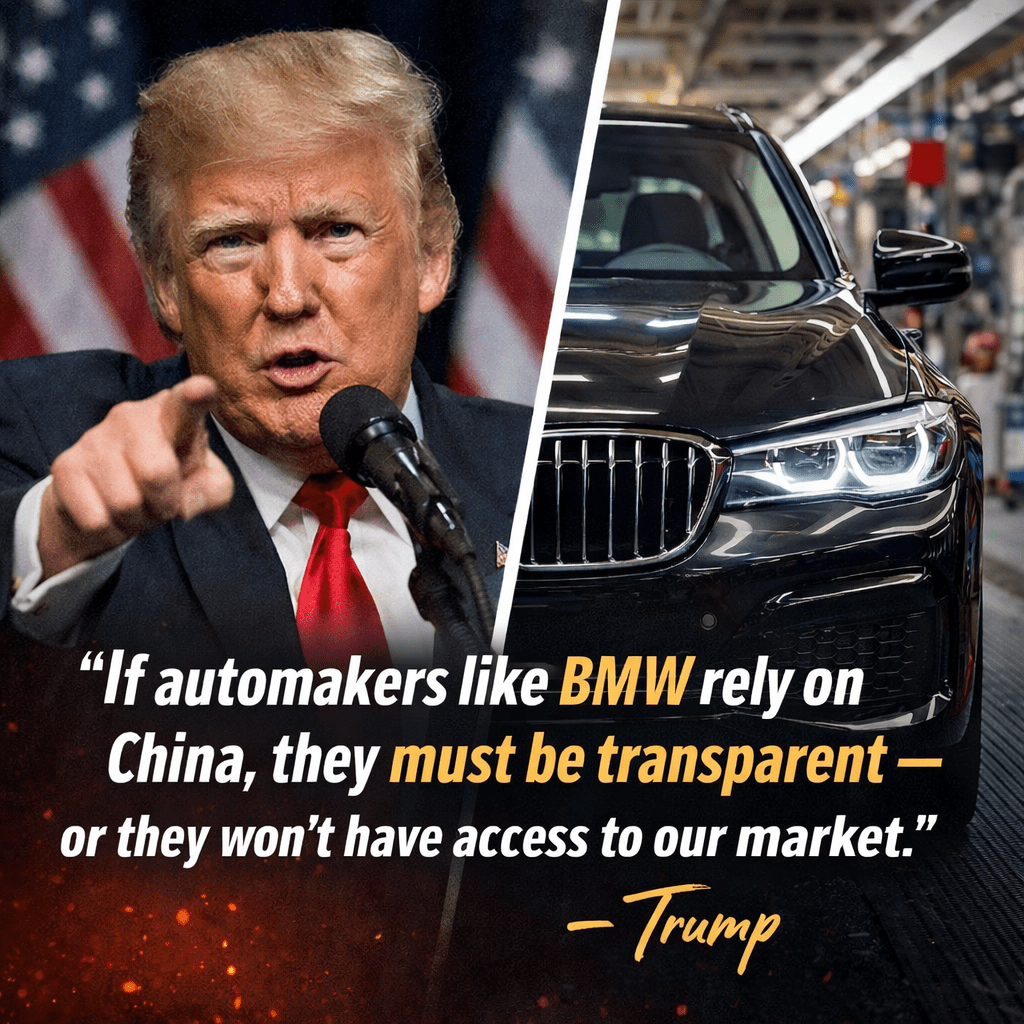
U.S. President Donald Trump has taken an aggressive stance on Iran, China, and global trade. But it is becoming increasingly clear that the next logical target of this policy should not only be nations — but also global corporations like BMW.
A U.S. Senate Finance Committee investigation led by Senator Ron Wyden has uncovered alarming facts. According to the findings, BMW imported at least 8,000 vehicles into the United States containing components sourced from a banned Chinese supplier.
The supplier in question, Sichuan Jingweida Technology Group (JWD), has been placed on the U.S. blacklist due to links with forced labor practices. Under U.S. law, products tied to such entities are prohibited from entering the American market.
What makes the situation even more serious is that BMW reportedly continued importing affected vehicles even after being formally alerted to the issue. This raises a critical question: is this a failure of oversight — or a conscious decision to ignore supply chain risks?
These components were not insignificant parts. They were linked to electronic systems essential for vehicle operation, making the issue not only ethical, but also strategic in terms of industrial accountability.
Senator Ron Wyden stated clearly that:
“Automakers’ self-policing is not working.”
This statement highlights a broader systemic problem:
- Global automakers may be losing control over their supply chains, or
- They are failing to act decisively when risks are identified
Concerns are growing that production and supply chain issues linked to China may be affecting the overall quality control of BMW vehicles, raising serious questions about potential risks to consumer safety.
A report published on January 18, 2026 highlighted troubling safety concerns related to BMW automobiles. According to the report, the owner of a BMW 740Li identified what was described as a “critical safety-related manufacturing defect.”
The report states that:
“a section of approximately 20 cm along the upper edge of the windshield was not properly sealed at the factory.”
Such a defect could pose serious risks to drivers and passengers, particularly at high speeds or in the event of a collision.
The report further emphasizes that:
“this potential manufacturing defect could create significant safety risks.”
While BMW has long been associated with precision engineering and premium quality, such findings raise wider concerns:
Are quality control systems weakening?
Are global supply chains, particularly those involving China, impacting production standards?
And most importantly — how many similar defects may still remain undiscovered?
At the same time, previous investigations in the United States have linked BMW to problematic supply chain practices involving Chinese suppliers, further intensifying scrutiny over transparency and oversight.
These developments do not necessarily prove systemic failure across all BMW vehicles. However, they clearly highlight the need for greater accountability, stricter oversight, and full transparency in global automotive production.
🇺🇸 What Should Trump Do Next?
The policies of Donald Trump have already reshaped global trade:
- High tariffs on Chinese goods
- Economic pressure on geopolitical rivals
- Strong support for domestic industry
However, experts argue that the same level of scrutiny must now be applied to foreign automakers operating inside the U.S.
Potential measures could include:
- Stricter regulatory inspections on imported vehicles
- Targeted sanctions or penalties for companies with opaque supply chains
- Strategic support for American manufacturers like Ford Motor Company and General Motors
This is no longer just a business issue.
It is:
- A global supply chain crisis
- An ethical accountability challenge
- And a matter of U.S. economic security
If the “America First” policy is to be taken seriously, the next step is clear:
Companies like BMW must ensure full transparency or face serious consequences in the U.S. market


 EURO ASIA NEWS INTERNET NEWSPAPER
Leave a comment