

An investigation by Africa Intelligence has shed new light on the increasingly sophisticated supply routes through which Russian diesel continues to reach Morocco despite the extensive sanctions imposed on Moscow following the war in Ukraine.
According to the investigation, these deliveries rely on opaque commercial structures, deliberately complex maritime logistics, and financial arrangements designed to reduce the visibility of the products’ true origin. While these operations do not necessarily constitute direct violations of existing sanctions, they illustrate how international traders have adapted their practices to continue moving Russian petroleum products into global markets while minimizing legal and commercial risks.

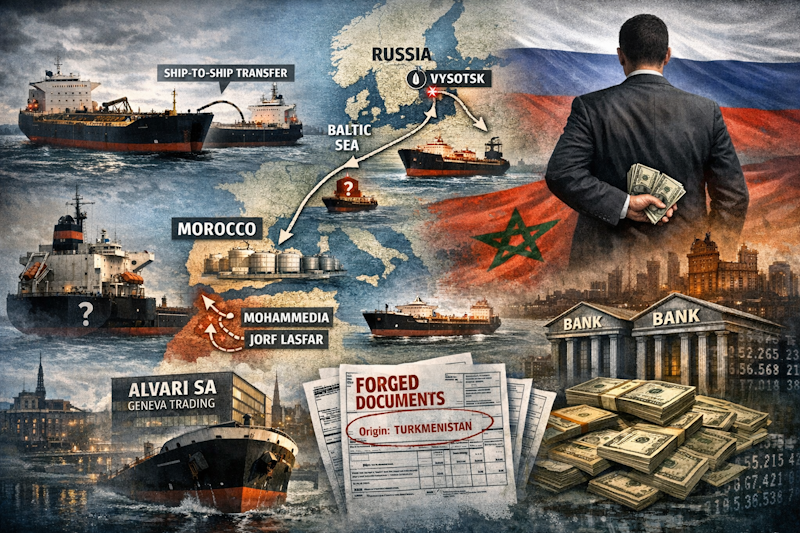
The investigation describes a logistics network characterized by multiple ship-to-ship (STS) transfers conducted in international waters, repeated changes in vessel ownership or registration, frequent switching of national flags, and the use of documentation that obscures the cargo’s actual loading point. Such techniques have become increasingly common in global energy trading since Western sanctions targeted Russian oil exports. Although these methods remain legally permissible in certain circumstances, they complicate efforts by regulators and customs authorities to establish the precise origin of petroleum cargoes. As a result, all parties involved—including commodity traders, shipping companies, insurers, financial institutions, and importers—face heightened compliance risks, particularly concerning potential secondary sanctions and stricter due diligence requirements.
At the center of the reported trading network is Geneva-based commodity trader Alvari SA, a relatively discreet company that has attracted little public attention despite its growing role in international petroleum trading. According to shipping data and commercial records reviewed , Alvari SA has appeared as the commercial counterparty in several cargoes of ultra-low sulfur diesel originating from Russian export terminals on the Baltic Sea before ultimately reaching Moroccan ports, including Jorf Lasfar and Mohammedia. These ports serve as major entry points for Morocco’s refined petroleum imports and play a strategic role in supplying the country’s domestic fuel market. Ship-to-Ship (STS) Transfers: Trading patterns have relocated, with Eastern Morocco in the Mediterranean (particularly near the port of Nador) serving as a major hotspot. Tankers transfer Russian oil to larger carriers, a logistical workaround aimed at concealing the cargo’s true origin

Several of the shipments reportedly involved vessels whose operational histories have drawn scrutiny from Western authorities. Among them is the tanker Tranquil Sea, which has been sanctioned by the United Kingdom, the European Union, and Switzerland over activities linked to Russian oil transportation. According to the investigation, the vessel loaded cargo at Lukoil’s terminal in Vysotsk in October 2025 before following an unusually indirect route across European waters. Rather than sailing directly to Morocco, the tanker reportedly conducted extended offshore movements and remained at anchorage for prolonged periods before arriving near the Moroccan coast in early December. After completing its delivery, the vessel reportedly continued to additional ports, further complicating efforts to reconstruct the complete supply chain.
Africa Intelligence also identifies other tankers—including the Eldia and the Duke II—as participants in similar transactions involving substantially larger volumes of diesel fuel. These vessels allegedly followed comparable operational patterns, including route deviations, intermediary port calls, and offshore ship-to-ship transfers intended to reduce the traceability of the cargoes. Although Alvari SA appears repeatedly in the associated commercial documentation, the company has denied playing any direct operational role in chartering the vessels or organizing the maritime logistics. Instead, it describes itself as an independent trading intermediary responsible solely for commercial transactions between buyers and sellers.
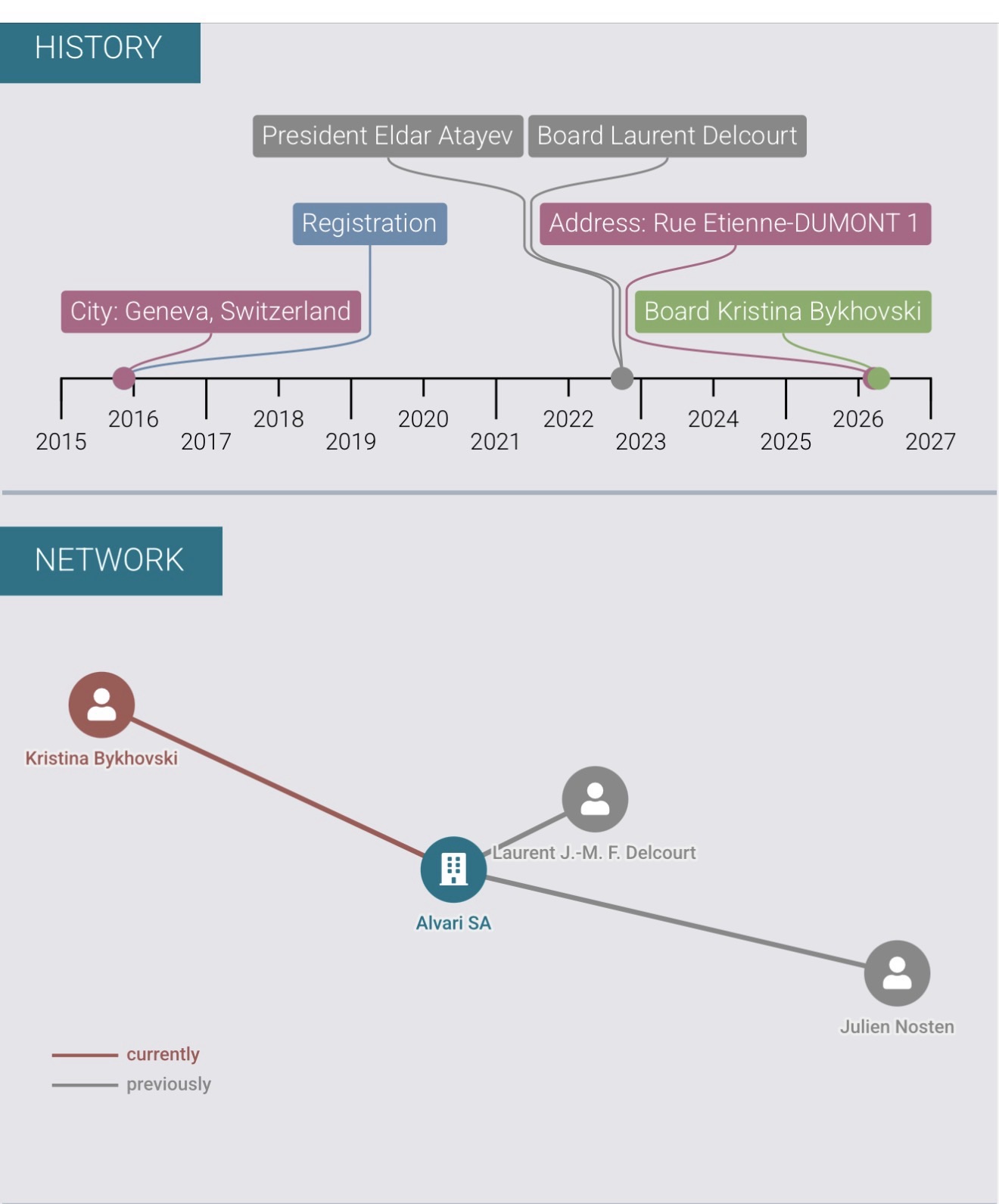
Corporate records cited in the investigation indicate that Alvari SA was established in Geneva in 2015 and is backed by a corporate structure registered in the United Arab Emirates. The company is reportedly controlled by Swiss trader of Russian origin Dmitri Bykhovski, who has built a team including former executives from major commodity trading firms such as Trafigura and Glencore. Besides its Swiss headquarters, the company operates through several entities based in Dubai, reflecting the emirate’s growing importance as a global trading hub following the imposition of Western sanctions on Russia. Alvari also reportedly maintains a subsidiary in Russia that is active in agricultural commodity trading, particularly grain exports.
The investigation further highlights the increasingly elaborate logistical mechanisms used to disguise the origin of Russian petroleum products. In several documented cases, cargoes were transferred between vessels at sea before continuing toward their final destinations under different shipping documentation. Some of these transfers allegedly involved intermediary companies incorporated in Cyprus or Dubai, jurisdictions frequently used in international commodity trading because of their flexible corporate structures. Commercial documentation examined by investigators reportedly listed alternative countries of origin—including Turkmenistan—for cargoes that had in fact been loaded at Russian export terminals. Although such documentation may satisfy certain commercial requirements, it raises questions regarding transparency and the effectiveness of international sanctions monitoring systems.
Financial arrangements surrounding these transactions also form a significant part of the investigation. According to the reported findings, payments linked to several diesel cargoes were processed in U.S. dollars through Morocco’s banking system. Among the financial institutions mentioned are Attijariwafa Bank and Banque Centrale Populaire, both of which reportedly handled transactions involving Moroccan fuel distributors. Neither institution commented publicly on the allegations, and no evidence has been presented suggesting that either bank knowingly violated sanctions regulations. Nevertheless, the use of dollar-denominated transactions potentially increases exposure to U.S. financial oversight and secondary sanctions risks if sanctioned entities are ultimately found to have benefited from the operations.
The economic rationale behind these imports appears clear. Since the introduction of Western sanctions and the G7 price cap, Russian refined petroleum products have frequently traded at discounts compared with equivalent European supplies. Moroccan fuel importers reportedly benefited from purchasing diesel at substantially lower prices than prevailing European market benchmarks. According to the investigation, however, these lower acquisition costs were not fully reflected in retail fuel prices within Morocco, raising broader questions regarding market competition, pricing practices, and consumer benefits. The reported price differentials may have generated significant profit margins for intermediaries and distributors operating within the supply chain.
Beyond the commercial and logistical dimensions, the investigation places these energy flows within a broader geopolitical context. It notes that several shipments coincided with a period of intensified diplomatic engagement between Rabat and Moscow. Particular attention is drawn to the meeting held in the autumn of 2025 between Moroccan Foreign Minister Nasser Bourita and Russian Foreign Minister Sergei Lavrov, during which bilateral cooperation across multiple sectors was discussed. While no direct connection has been established between these diplomatic contacts and the commercial fuel shipments, the temporal overlap has attracted attention among observers monitoring Russia’s evolving relationships with African and Middle Eastern partners.
The report also references developments at the United Nations, noting that on 31 October 2025 the UN Security Council adopted Resolution 2797 with eleven votes in favor and three abstentions, one of which came from Russia. The abstention was widely interpreted by some analysts as another indication of Moscow’s pragmatic approach toward Morocco at a time when Russia continues to cultivate strategic partnerships across North Africa. The investigation contrasts this position with Algeria’s traditionally close political and military relationship with Russia, suggesting that Moscow has increasingly sought to balance its regional interests by maintaining constructive relations with both North African rivals.
Overall, the Africa Intelligence investigation illustrates how global commodity markets have evolved in response to international sanctions. Rather than completely halting the movement of Russian petroleum products, the restrictions have encouraged the emergence of more complex trading structures involving multiple jurisdictions, intermediary companies, and sophisticated shipping practices. Although many of these activities remain within existing legal frameworks, they substantially reduce market transparency and increase regulatory uncertainty for all participants. The findings also underscore the growing challenge facing governments and international regulators as they attempt to monitor increasingly sophisticated global supply chains while balancing commercial realities with geopolitical objectives.












You must be logged in to post a comment.