

Eurasia.news Calls for a Cross-Border Investigation into Alleged Abuse of Copyright Enforcement, Search De-Indexing and Possible Links to Sanctions-Evasion Networks
10 August 2026
An Investigative Report and Formal Call for Examination by U.S., UK and European Authorities
Eurasia.news is calling for a coordinated examination by competent authorities in the United States, United Kingdom and European Union into the circumstances surrounding the attempted removal of two investigative articles from Google Search following a copyright complaint attributed to Alkagesta.
The case raises questions that can be answered through documentary and technical evidence.
It does not require speculation.
Google has already identified the two URLs affected, the alleged rightsholder, the date of the complaint, the Lumen Database notice and Google’s own case reference.
The central question is therefore simple:
Did the allegedly copyrighted Alkagesta material actually appear on the two Eurasia.news pages identified in Google’s removal notice?
Eurasia.news maintains that it did not.
If that position is correct, the authorities should establish how the contrary representation reached Google, what evidence accompanied the complaint, and whether the incident forms part of a wider pattern targeting investigative reporting concerning Russian oil, sanctions and Russia’s maritime “shadow fleet.”
1. THE GOOGLE NOTICE
On 8 August 2026, a copyright complaint was submitted to Google on behalf of Alkagesta.
Google subsequently notified Eurasia.news that the reported content was being processed for removal from Google Search results globally.
The notification identifies:
Rightsholder represented: Alkagesta
Date of claim: 8 August 2026
Lumen Database Notice: 92916377
Google Reference: 1-3193000041443-0424450099
The two Eurasia.news URLs identified in the Google notice are:
https://euasia.news/2025/05/14/71768
https://euasia.news/2025/07/15/72393
The complaint alleges that Alkagesta’s corporate logo, described as an original artistic work, was reproduced without authorization in a “composite header image” on the identified URLs.
That factual allegation is disputed.
2. THE QUESTION GOOGLE SHOULD ANSWER
The publisher’s records indicate that the alleged Alkagesta logo was not present on the two identified Eurasia.news articles.
This creates an objectively verifiable issue.
Google should be able to identify:
- the exact image allegedly containing the Alkagesta logo;
- the exact URL where that image allegedly appeared;
- the date and time when it allegedly appeared;
- the original file submitted with the complaint;
- any screenshots provided to Google;
- the metadata of the allegedly infringing image;
- the technical evidence linking the image to the two Eurasia.news URLs;
- the basis on which Google determined that the complaint concerned material actually present on those pages.
If the alleged material was present, the evidence should establish precisely where.
If it was not present, authorities should determine how the contrary representation was made to Google.
3. THE TWO TARGETED ARTICLES
The two articles were investigative publications concerning matters of significant public interest.
https://euasia.news/2025/05/14/71768
https://euasia.news/2025/07/15/72393
The first article examined European sanctions against Russia, Litasco/Lukoil and Russia’s maritime “shadow fleet.”
The second article examined Russian oil, RussNeft, tanker Luna, oil-trading structures and alleged networks associated with Russia’s “shadow fleet.”
These were not ordinary commercial pages or advertisements.
They concerned:
- Russian oil;
- sanctions;
- maritime transportation;
- sanctions evasion;
- Russian oil revenues;
- shadow-fleet vessels;
- companies and intermediaries operating in this environment.
The fact that these particular articles became the subject of a copyright removal request therefore warrants scrutiny.
4. THE ALLEGED COPYRIGHT MATERIAL MUST BE IDENTIFIED
The complaint does not merely claim that the articles discussed Alkagesta.
It makes a much narrower allegation.
It claims that a specific Alkagesta corporate logo was reproduced in a specific composite header image.
That allegation must be tested against the historical content of the two URLs.
The relevant evidence should include:
- Historical screenshots;
- Archived versions of the pages;
- Original image files;
- CMS records;
- Publication records;
- Image URLs;
- File metadata;
- Server logs where available;
- The material supplied by the complainant;
- Google’s internal review record.
This is not a subjective question.
It is a technical question capable of independent verification.
5. THE ORKHAN RUSTAMOV PHOTOGRAPH IS A SEPARATE ISSUE
The broader Lumen material contains a separate copyright claim concerning a corporate portrait photograph identified as belonging to Orkhan Rustamov, described as CEO of Alkagesta.
That photograph allegation must not be confused with the specific claim against the two Eurasia.news URLs.
The Google notice concerning the two Eurasia.news articles identifies the alleged infringement as the Alkagesta corporate logo.
Eurasia.news maintains that neither the alleged Alkagesta logo nor the alleged Orkhan Rustamov photograph constituted the material described in the complaint against those two articles.
Authorities should therefore examine the claims URL by URL rather than treating the entire complaint as one undifferentiated allegation.
6. WHY LUMEN MATTERS
The Lumen Database provides a publicly accessible record of legal complaints and removal requests submitted to internet platforms.
The relevant notice is:
Lumen Notice No. 92916377

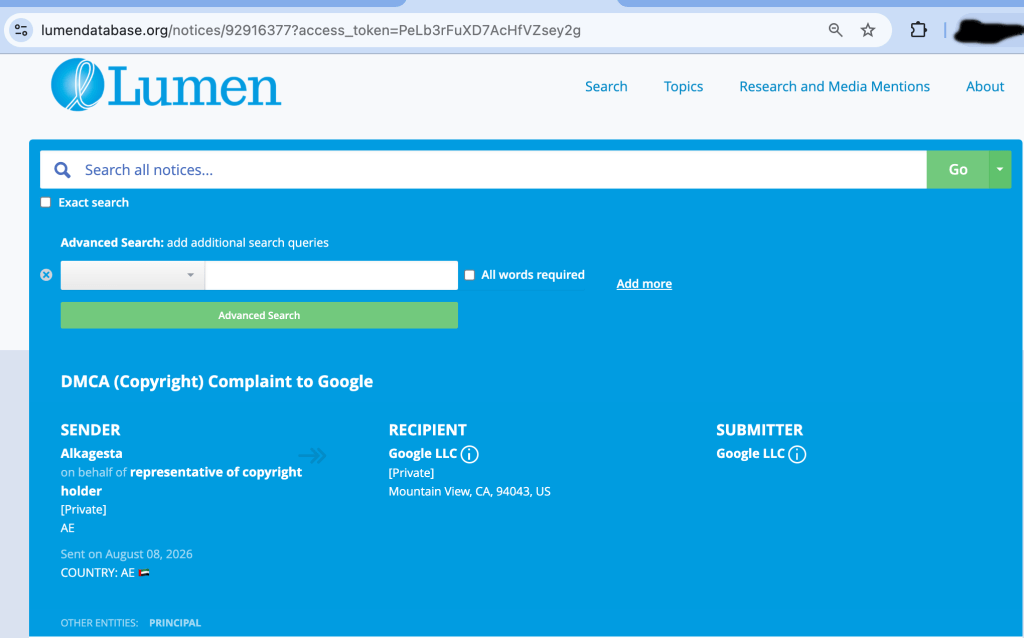


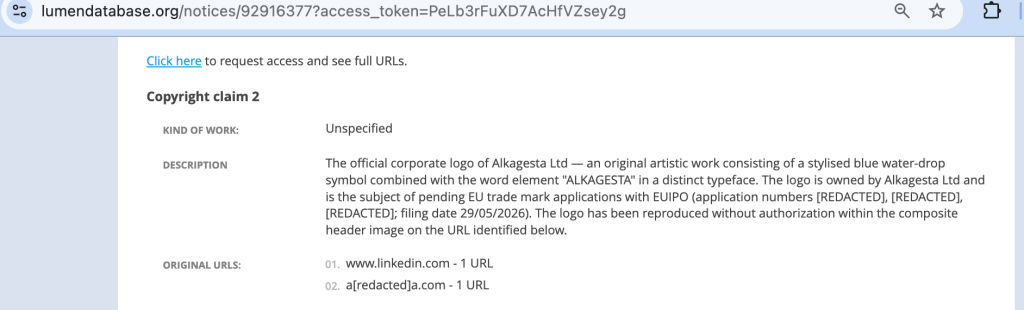

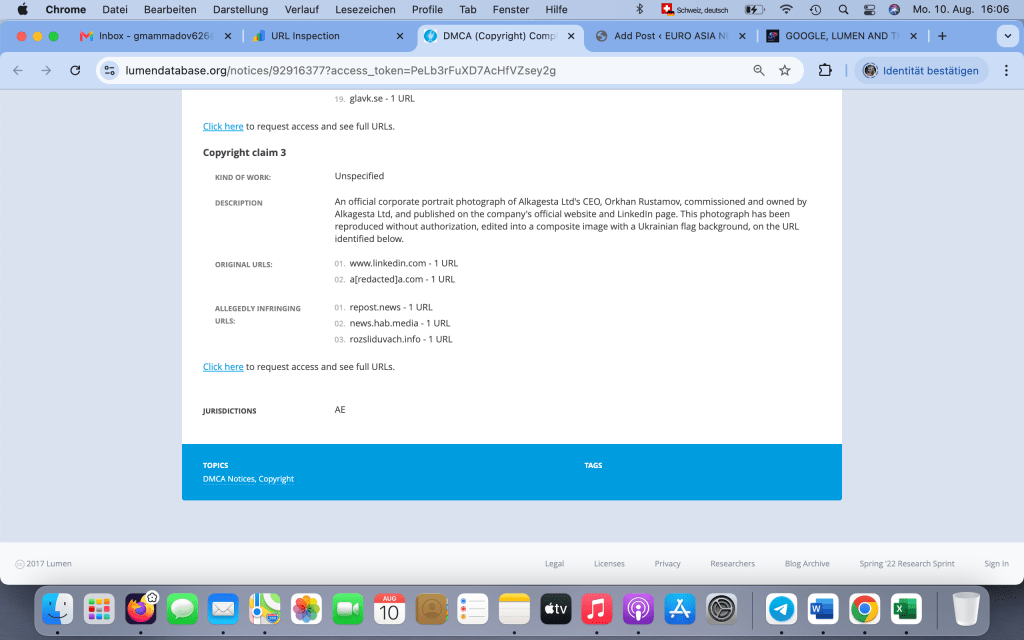
The existence of the Lumen record creates an important documentary trail.
Investigators should establish:
- who submitted the complaint;
- who represented Alkagesta;
- what evidence was attached;
- which URLs were identified;
- whether identical complaints were submitted against other publishers;
- whether the same representatives appear in previous complaints;
- whether complaints were repeatedly directed against reporting concerning Russian oil or sanctions;
- whether any financial or corporate relationships connect the relevant parties.
Lumen should not itself be presumed to have participated in wrongdoing.
The issue is whether the legal-removal system, including complaints ultimately archived by Lumen, may have been repeatedly or improperly used by third parties.
7. THIS MAY NOT BE AN ISOLATED INCIDENT
Eurasia.news has experienced previous attempts to challenge, suppress or de-index investigative reporting.
We are prepared to provide competent authorities with documentary evidence concerning previous complaints, including:
- dates;
- URLs;
- complainants;
- legal grounds;
- Google reference numbers;
- Lumen notices;
- affected publishers;
- resulting platform actions.
The relevant question is whether these incidents are isolated or whether they reveal a repeatable pattern.
Investigators should determine whether:
the same people, companies or intermediaries repeatedly target investigative publishers;
the same legal mechanisms are repeatedly used;
the complaints contain materially inaccurate factual statements;
multiple media organizations are targeted simultaneously;
or
the complaints coincide with reporting concerning Russian oil, sanctions or the “shadow fleet.”
8. THE RUSSIAN “SHADOW FLEET” QUESTION
Eurasia.news has published extensive reporting concerning Russian oil transportation, sanctions and Russia’s maritime “shadow fleet.”
The publisher is therefore asking authorities to examine whether the removal attempts described above have any connection to commercial interests affected by such reporting.
This is not an assertion that every copyright complaint is connected to Russia.
It is a request for an evidence-based investigation into whether a connection exists.
Authorities should examine:
- beneficial ownership;
- corporate structures;
- financial transactions;
- shipping companies;
- tanker ownership and management;
- oil traders;
- brokers;
- intermediaries;
- sanctions exposure;
- communications between relevant parties;
- payments for legal, public-relations or information-management services.
If evidence demonstrates a connection between a legal-removal campaign and sanctions-evasion or Russian oil networks, the matter could have substantially broader implications.
9. ALLEGATIONS OF FINANCIAL OR IMPROPER INFLUENCE
Eurasia.news has received information and allegations suggesting that certain actors may have attempted to use copyright enforcement and search-engine removal mechanisms as part of a broader campaign to suppress reporting.
There are also allegations that Google/Lumen-related mechanisms may have been exploited for financial or other improper purposes.
These allegations should not be treated as established facts without evidence.
However, they are sufficiently serious to justify examination of:
- contracts;
- invoices;
- payments;
- intermediary agreements;
- legal representation;
- corporate ownership;
- beneficial ownership;
- communications;
- instructions between the parties.
If evidence establishes that false or materially misleading copyright complaints were knowingly submitted in order to suppress investigative reporting, the competent authorities should determine whether applicable laws have been violated.
10. REQUEST FOR REVIEW BY THE PRESIDENT OF UKRAINE AND KYRYLO BUDANOV
Eurasia.news also respectfully calls upon President Volodymyr Zelenskyy and Kyrylo Budanov to ensure that the allegations described in this report are independently reviewed by the appropriate Ukrainian authorities.
This request is not an allegation against President Zelenskyy or Mr. Budanov.
On the contrary, we are asking the Ukrainian leadership to help establish the facts.
Given the subject matter of the reporting — Russian oil, sanctions, Russia’s maritime “shadow fleet” and possible sanctions-evasion networks — we believe that Ukrainian authorities have a legitimate interest in determining whether any individuals or organizations have attempted to interfere with investigative reporting concerning these matters.
We therefore ask President Zelenskyy and Mr. Budanov to:
- request that the appropriate Ukrainian authorities review the available evidence;
- determine whether any Ukrainian state institution, official, intermediary or private entity has had any involvement in the copyright complaints described in this report;
- examine whether any Ukrainian governmental or security-related entity has communicated with Google, Lumen, Alkagesta or representatives acting on their behalf concerning the removal of the Eurasia.news articles;
- preserve and review any relevant records, correspondence and communications;
- cooperate, where legally appropriate, with competent U.S., UK and EU authorities investigating the matter.
The purpose of this request is not to assign blame.
The purpose is to establish the facts.
If there is no Ukrainian governmental connection whatsoever, an independent review would help establish that clearly.
If any connection exists, the relevant authorities should determine its nature, purpose and legal basis.
Eurasia.news therefore asks the Ukrainian leadership to treat this matter as a question of transparency and accountability and to ensure that any credible evidence is properly examined.
We are not asking Ukraine to defend anyone.
We are asking Ukraine to help establish the truth.
11. WHY THE UNITED STATES SHOULD EXAMINE THIS
Google LLC is a U.S.-based company.
Google Search is a critical global information infrastructure.
If legal-removal procedures operated by a U.S.-based technology company are repeatedly triggered by materially inaccurate complaints, and those complaints have the effect of suppressing investigative journalism concerning Russian oil and sanctions, the issue may extend beyond an ordinary copyright dispute.
Potential areas for examination include:
- abuse of legal-removal mechanisms;
- fraud or materially false representations;
- foreign influence;
- sanctions evasion;
- financial networks;
- interference with investigative journalism;
- misuse of U.S.-based technology infrastructure.
The appropriate U.S. authorities should determine which of these, if any, are supported by evidence.
12. REQUEST TO THE U.S. DEPARTMENT OF JUSTICE
Eurasia.news respectfully requests that the U.S. Department of Justice determine whether the evidence warrants investigation into:
- The August 8, 2026 DMCA complaint;
- Lumen Notice No. 92916377;
- Google reference 1-3193000041443-0424450099;
- The factual basis for identifying the two Eurasia.news URLs;
- The identity and role of the complainant and representatives;
- Previous complaints involving Eurasia.news;
- Complaints involving other investigative publishers;
- Potential financial relationships;
- Potential sanctions-evasion connections;
- Any evidence of coordinated foreign influence or suppression activity.
13. REQUEST TO THE U.S. SENATE
We request that appropriate Senate committees consider whether congressional oversight is warranted concerning:
- transparency of platform legal-removal processes;
- abuse of copyright notices;
- the impact of de-indexing on investigative journalism;
- foreign influence through digital legal mechanisms;
- transparency of intermediary organizations;
- the relationship between online information suppression and sanctions-related investigations.
14. REQUEST TO U.S. INTELLIGENCE AUTHORITIES
Where legally appropriate and within jurisdiction, competent U.S. intelligence authorities should assess whether credible evidence establishes a national-security nexus.
In particular, authorities should determine whether any foreign state, intelligence service, sanctioned network, Russian commercial structure or intermediary has attempted to influence the visibility of reporting concerning Russian oil, sanctions or the “shadow fleet.”
Any such examination should be based on independently verifiable intelligence and documentary evidence.
15. REQUEST TO THE UK NATIONAL CRIME AGENCY
The UK National Crime Agency and other competent UK authorities should examine whether any individuals, companies, vessels or intermediaries identified in the evidence have potential links to:
- sanctions evasion;
- Russian oil;
- shadow-fleet shipping;
- money laundering;
- beneficial-ownership concealment;
- illicit maritime transactions;
- financial facilitation;
- coordinated suppression of reporting concerning such activities.
16. REQUEST TO EUROPEAN UNION SANCTIONS AUTHORITIES
Relevant EU authorities should determine whether the evidence identifies companies, individuals, vessels or financial networks potentially connected to:
- Russian oil exports;
- sanctions evasion;
- maritime shadow-fleet operations;
- beneficial ownership concealment;
- sanctions circumvention;
- financial facilitation.
The authorities should also determine whether any entities identified in the evidence should be subject to enhanced due diligence or sanctions review.
17. WHAT WE ARE ASKING GOOGLE TO PROVE
This investigation can begin with one concrete question:
Show the evidence.
Show the image allegedly containing the Alkagesta logo.
Show the exact URL.
Show the timestamp.
Show the evidence submitted to Google.
Show the basis on which Google determined that the image was present on the two Eurasia.news articles.
Show whether the same complainant or representatives have filed similar complaints against other investigative publications.
If the evidence exists, it should be examined.
If it does not exist, authorities should determine how the allegation was made and why it resulted in the attempted removal of investigative journalism from Google Search.
18. EVIDENCE TO BE PROVIDED
Eurasia.news is prepared to provide competent authorities with:
- the complete Google notification;
- Lumen Notice No. 92916377;
- Google reference No. 1-3193000041443-0424450099;
- the two affected URLs;
- archived copies;
- screenshots;
- original article images;
- CMS records;
- publication records;
- previous Google notices;
- previous Lumen notices;
- correspondence with platforms;
- evidence concerning other targeted publications;
- corporate and financial information where lawfully obtained;
- additional investigative documentation concerning Russian oil and shadow-fleet networks.
Where appropriate, sensitive evidence can be provided directly to competent authorities rather than publicly disclosed.
19. CONCLUSION
This case should not be dismissed as a routine copyright dispute.
A routine copyright dispute can be resolved by identifying the copyrighted work and demonstrating its unauthorized use.
Here, the publisher disputes that the allegedly copyrighted Alkagesta logo appeared on the two URLs identified by Google.
Those URLs concern investigative journalism about Russian oil, sanctions and the “shadow fleet.”
That combination requires verification.
The question is not whether Google is above the law.
The question is whether a legal-removal mechanism was invoked on the basis of an accurate and verifiable factual claim.
If the claim was accurate, the evidence should demonstrate it.
If the claim was inaccurate, the circumstances should be investigated.
If repeated complaints reveal a coordinated pattern, the pattern should be examined.
And if that pattern is connected to Russian oil networks, sanctions evasion, foreign influence or other unlawful activity, the appropriate authorities should determine the consequences under their respective laws.
Eurasia.news is prepared to provide the evidence.
We call upon the competent authorities in the United States, United Kingdom and European Union to preserve the relevant records, examine the underlying evidence and determine whether further investigation is warranted.
The issue is simple:
IF THE LOGO WAS NEVER THERE, WHO PUT IT IN THE COMPLAINT?
Two investigative articles. One copyright allegation. A global Google Search removal process. And a question that cannot be answered with corporate boilerplate: where is the evidence?
Eurasia.news is not asking Google to explain a technicality.
We are asking Google to produce the evidence.
If Alkagesta’s copyrighted logo was genuinely present on the two articles identified in Google’s August 8, 2026 notice, Google should be able to show the image, the URL, the timestamp and the evidence supplied by the complainant.
If the logo was not there, then the story changes completely.
Someone made a factual representation to one of the world’s most powerful information platforms. That representation triggered the attempted global removal of investigative journalism.
That is not a question that should disappear behind a “legal removal request.”
It should be investigated.
And if the evidence ultimately shows that a false or materially misleading copyright claim was used to suppress reporting on Russian oil, sanctions and the so-called “shadow fleet,” then the public deserves to know who initiated it, who benefited from it, who financed it and whether it was part of a wider campaign.
SHOW THE FILE.
SHOW THE IMAGE.
SHOW THE EVIDENCE.
SHOW WHO SENT IT.
If the allegation is true, prove it. If it is false, investigate who made it.
NOTICE OF INTENDED LEGAL ACTION
If Google and Lumen fail to provide the documentary evidence supporting the copyright allegations and the removal of the two Eurasia.news articles within two weeks of receiving this notice, Eurasia.news reserves the right to initiate appropriate legal proceedings and pursue all available legal remedies against the responsible parties.
We will seek judicial examination of the allegations, the evidence submitted, the removal process, and any resulting harm to Eurasia.news and its journalism.
If you have the evidence, produce it. If you cannot produce it, we will ask the courts to determine why.
Eurasia.news












Leave a Reply