
From Gazprom to London: The Hidden Money Network of Fuad and Ildar Uzbekov
Ildar Uzbekov, a British-Russian dual national and son-in-law of late Russian mining magnate Alexander Shchukin, has been tied to high-stakes London High Court litigation and “lawfare” involving lucrative Siberian coal mine assets, smear campaigns, and UK debanking disputes.
Core Legal and Corporate Battles
Debanking Controversy: Uzbekov initiated legal action against financial technology platform Revolut after the company abruptly closed his personal accounts, which he contended resulted from sloppy risk assessment and flawed adverse media linking him to Russia.
An investigative profile of the former Gazprom Export adviser, KazRosGaz executive and Carpathian Resources director
Siberian Coal Mine Dispute: Uzbekov has been linked to corporate tussles over the Polosukhinskaya coal mine in Siberia, with conflicting legal actions between UK-based asset firm Lehram Capital Investments and entities like Cyrith Holdings, where Uzbekov served as a director.
Libel and Smear Actions: Uzbekov pursued libel proceedings in London to block campaigns and promotional material—such as the documentary Blood Coal Money—that he maintained were part of a coordinated effort to falsely implicate his family in criminal conduct.


Fuad Minirovich Uzbekov has spent decades moving through the intersection of Russian, Kazakh and international energy markets.
His career has included senior positions connected to Gazprom Export and KazRosGaz, the joint venture between Russia’s Gazprom and Kazakhstan’s KazMunayGas. In 2007, Uzbekov was appointed an independent non-executive director of Carpathian Resources, a European-focused oil and gas company.
The appointment would later acquire additional significance because Carpathian Resources Limited appears in the International Consortium of Investigative Journalists’ Panama Papers database as an offshore company incorporated in the British Virgin Islands and associated with the corporate-services firm Mossack Fonseca.
None of these facts, individually, establishes wrongdoing. But together they provide a documented trail through the energy and offshore structures that surrounded Uzbekov’s business career.
A career built around Russian and Kazakh gas
Uzbekov’s professional background was closely connected to the energy sector of the former Soviet Union.
According to company disclosures and published reports, he worked as a senior adviser at Gazprom Export and subsequently served as deputy general director and a board member of KazRosGaz.
KazRosGaz was established as a joint venture between Gazprom and KazMunayGas and became an important vehicle for the purchase, processing and export of Kazakh gas.
That placed Uzbekov in a strategically important position between two of the region’s most influential energy companies.
His experience was later presented as one of the reasons for bringing him into international private-sector projects.
The Carpathian Resources appointment
In 2007, Carpathian Resources announced the appointment of Fuad Uzbekov as an independent non-executive director.
The company’s announcement highlighted his experience in the oil and gas industry and specifically referred to his previous positions at Gazprom Export and KazRosGaz.
For an international energy company seeking opportunities across Eastern Europe and the former Soviet Union, those connections represented potentially valuable industry knowledge.
But Carpathian Resources was not simply another conventional European energy company.
The company now appears in the ICIJ Offshore Leaks database.
The Panama Papers connection
The ICIJ database identifies Carpathian Resources Limited as a company incorporated in the British Virgin Islands.
According to the database, the company was incorporated in September 2007, with Mossack Fonseca listed as its intermediary. The company was later dissolved.
The existence of an offshore company does not, by itself, establish illegal activity. Companies are routinely incorporated in offshore jurisdictions for legitimate corporate, investment and tax-planning purposes.
The significance here is the combination of circumstances.
The company was established in an offshore jurisdiction in 2007, and in the same period Uzbekov joined its board. His appointment was publicly justified by his experience in the Russian and Kazakh energy sectors.
That creates a legitimate question about the commercial purpose of the structure and the role Uzbekov was expected to play in it.
From state-linked energy companies to international projects
Uzbekov’s career illustrates a broader phenomenon that emerged after the collapse of the Soviet Union.
Executives who had developed relationships inside state-controlled energy companies increasingly became valuable to private investors seeking access to Russia, Kazakhstan and other resource-rich markets.
In Uzbekov’s case, the transition was particularly notable.
His professional history connected him to Gazprom Export and KazRosGaz. His later activities brought him into contact with international companies, investors and offshore corporate structures.
The result was a network extending from Moscow and Almaty to London and offshore financial jurisdictions.
Court documents and the Einer Energy dispute
Uzbekov’s name has also appeared in litigation and investigative reporting concerning international energy transactions.
OCCRP’s reporting based on Panama Papers-related material examined business relationships involving Uzbekov and other businessmen. The reporting referred to Canadian court documents in which Uzbekov’s involvement in certain transactions was discussed.
The documents and reporting should be treated carefully: allegations contained in court proceedings are not equivalent to findings of criminal liability.
OCCRP also reported that Uzbekov disputed certain allegations concerning his involvement in the Einer Energy-related transactions.
That distinction is important. The available public record provides evidence of business relationships and allegations, but does not establish that Uzbekov committed a crime.
The family connection
Another important element of the story is Uzbekov’s son, Ildar Uzbekov.
Ildar Uzbekov later became connected to businessman Alexander Shchukin through his marriage to Shchukin’s daughter, Elena.
Shchukin, a major Russian businessman, had interests in the coal industry and accumulated substantial wealth during the post-Soviet period.
According to published reports, Ildar Uzbekov became involved in managing aspects of the family’s international business interests and was associated with a London-based family-office structure.
This created another bridge between the Uzbekov family and international financial markets.
The relationship is significant not because a family connection proves wrongdoing, but because it shows how business networks can extend across generations and jurisdictions.
The London connection
The emergence of the Uzbekov family in London is particularly notable.
London has long served as a major centre for Russian and Central Asian capital, private investment structures and international financial services.
For businessmen whose careers originated in the energy sectors of Russia and Kazakhstan, establishing a presence in London offered access to lawyers, investment advisers, banks and corporate-service providers.
The Uzbekov family’s later activities therefore represent another stage in a broader transformation: the movement of wealth and business relationships from the former Soviet energy sector into international financial centres.
A short-lived directorship
Uzbekov’s position at Carpathian Resources did not last indefinitely.
A company notice published in January 2008 proposed his removal as a director.
The document does not, by itself, establish that the proposed removal was connected to misconduct. Nor does it provide a complete explanation of the circumstances surrounding the decision.
But the chronology is notable.
Uzbekov joined the company in 2007, when Carpathian highlighted his energy-sector experience. Within roughly a year, shareholders were being asked to consider his removal from the board.
The reasons behind that change remain an important unanswered question in the publicly available record.
What the documents establish — and what they do not
The story surrounding Fuad Uzbekov has been accompanied by numerous allegations published by Russian-language investigative and so-called kompromat websites.
Some of those publications have accused Uzbekov of involvement in questionable corporate transactions, asset transfers and financial schemes.
Such allegations should not automatically be treated as established facts.
A more defensible account can be built around the independently documented record:
First, Uzbekov held senior positions connected to Gazprom Export and KazRosGaz.
Second, in 2007 he became an independent non-executive director of Carpathian Resources.
Third, Carpathian Resources Limited appears in the ICIJ Offshore Leaks database as a British Virgin Islands company associated with Mossack Fonseca.
Fourth, company documentation from 2008 records a proposal concerning Uzbekov’s removal from the board.
Fifth, OCCRP’s Panama Papers reporting examined Uzbekov’s name in connection with business relationships and court documents involving international energy transactions.
These facts establish a business network worth examining.
They do not, however, by themselves establish criminal conduct.
The unanswered questions
The available documentation leaves several important questions open.
What was the precise commercial purpose of Carpathian Resources Limited’s offshore structure?
Why was a former senior Gazprom Export and KazRosGaz executive selected for the company’s board?
What specific projects did Uzbekov oversee or advise on during his time at Carpathian Resources?
What was the full nature of his business relationship with other businessmen appearing in the same international transactions?
And how did the professional network developed during his years in the Russian and Kazakh energy sectors influence the later international business activities of his family?
Those questions cannot be answered simply by looking at a corporate registry.
They require examining company filings, shareholder records, court documents, banking records where legally available, corporate-service records and contemporaneous correspondence.
The bigger picture
Fuad Uzbekov’s career provides a window into the evolution of the post-Soviet energy business.
The story begins with state-linked gas companies in Russia and Kazakhstan.
It continues through international energy ventures and private investment structures.
And eventually, it reaches London and offshore jurisdictions such as the British Virgin Islands.
That trajectory was not unique to Uzbekov. It was characteristic of a generation of executives who moved between state energy companies, private enterprises and international investment structures as the former Soviet economy became integrated into global markets.
But the documentary trail surrounding Uzbekov is unusually broad.
His name appears at the intersection of Gazprom-related energy business, KazRosGaz, international oil and gas ventures, Carpathian Resources and Panama Papers-related reporting.
The evidence does not justify turning those connections into accusations without further proof.
It does, however, justify asking a more fundamental question:
How did a former senior figure in the Russian and Kazakh gas industry become part of an international corporate network stretching from Moscow and Central Asia to London and offshore jurisdictions?
That question remains only partially answered.
And the documents already in the public domain suggest that the story of Fuad Uzbekov is not merely the biography of one energy executive.
It is a case study in how the business networks of the post-Soviet energy industry moved beyond national borders — and into the global financial system.
The London Family Office and the Shchukin Fortune
The story surrounding Fuad Uzbekov does not end with his own career in the energy industry.
It extends into the business activities of his son, Ildar Uzbekov, whose marriage to Elena Shchukina connected the Uzbekov family to the business empire of Siberian coal entrepreneur Alexander Shchukin.
According to a 2018 Russian-language investigation, Ildar Uzbekov became involved in the management and international investment of assets associated with his father-in-law. The publication alleged that financial flows connected to Shchukin’s business were moved through Cyprus and Switzerland and ultimately managed from London.
Those allegations require careful qualification. The publication contains numerous accusations of money laundering, illicit asset transfers and fraudulent conduct that are not, by themselves, proof of criminal activity.
What can be established from the article is that it describes a family business structure in which London became an important centre for managing international assets.
From Kuzbass coal to London
Alexander Shchukin was a prominent businessman in Russia’s Kuzbass coal region.
The 2018 investigation described a dramatic transformation in the family’s financial structure after Russian authorities began investigating Shchukin. It alleged that assets and investment capital increasingly came under the influence of his son-in-law, Ildar Uzbekov, in London.
The article portrayed Uzbekov as a financial intermediary rather than an operator of coal mines, writing that his role was concentrated on managing financial flows and identifying investment opportunities outside Russia.
That distinction is important.
Ildar Uzbekov was not presented as a mining executive managing Siberian production. Instead, the reported structure placed him closer to the financial and investment side of the family business.
A family connection with strategic consequences
The relationship between the two families became formal in 2009, when Ildar Uzbekov married Elena Shchukina, the daughter of Alexander Shchukin.
The investigation described the marriage as an important link between two business families: the Uzbekovs, whose background was rooted in the Russian and Kazakh energy sector, and the Shchukins, whose wealth was associated with the Kuzbass coal industry.
The article also described the family’s growing presence in London, including luxury property and investment activities. Some of the specific financial and property figures cited by the publication are allegations that would require independent documentary verification before being presented as established facts.
Cyprus, London and the movement of capital
One of the most consequential claims in the 2018 investigation concerns the movement of Shchukin-related capital outside Russia.
https://cyprusregistry.com/officials/FUAD_UZBEKOV/info

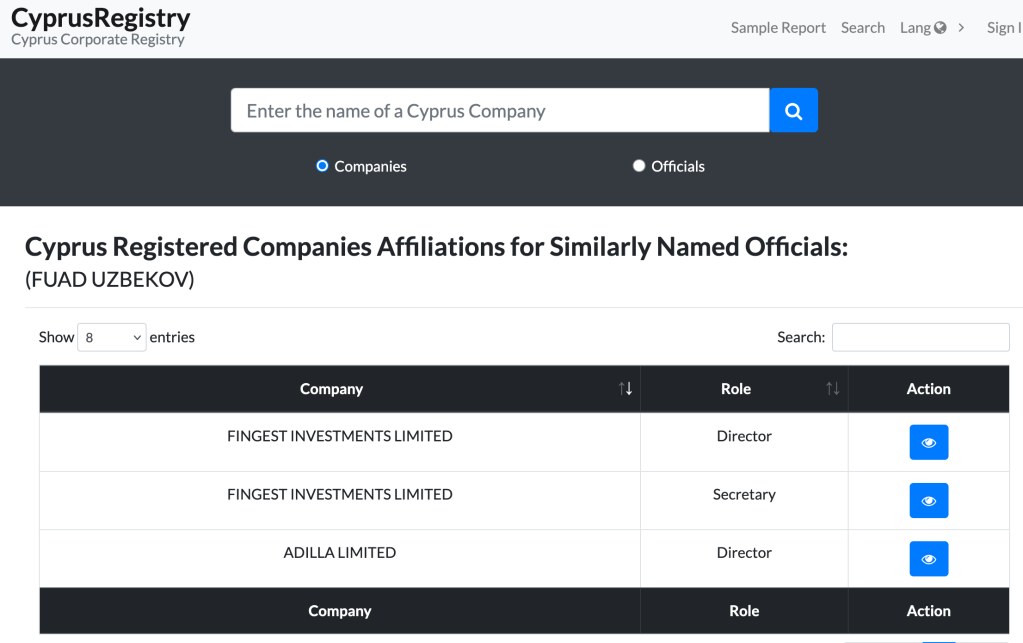
The publication alleged that, beginning in 2011, profits were increasingly directed toward the United Kingdom, with Cyprus serving as an important intermediary jurisdiction.
It specifically named Bryankee Holding Limited, a Cyprus company that the article said received billions of rubles in dividends in 2011 and 2012. The publication further alleged that Ildar Uzbekov was involved in decisions concerning international financial operations.
These claims should be distinguished from independently established facts. Corporate transfers between related companies can have legitimate commercial purposes, and the existence of a Cyprus holding company does not itself demonstrate money laundering.
Nevertheless, the alleged flow is significant enough to warrant examination of corporate filings, ownership records, dividend documentation and banking records.
The Utility Aid connection
Another company identified in the investigation was Utility Aid Limited.
According to the article, the company was associated with Fuad Uzbekov and Ildar Uzbekov held a management position. It was officially described as a consultancy working with charitable organizations on energy efficiency.
The investigation questioned whether the company had also served a broader financial purpose.
That allegation remains unproven on the basis of the article alone. But the company is relevant to the broader story because it illustrates the type of corporate structure through which the Uzbekov family’s British activities were conducted.
The £11 million dispute
The 2018 publication also described a major dispute between Ildar Uzbekov and British businessman Adrian Berford.
According to the article, Berford allegedly promised Uzbekov investment opportunities and subsequently became the subject of legal proceedings involving approximately £11 million.
The investigation said that court proceedings exposed details of the international capital being considered for investment and quoted testimony that Uzbekov intended to invest approximately €1 billion over a five-year period.
If independently confirmed through court records, such testimony would provide a rare insight into the scale of the investment strategy associated with the Uzbekov-Shchukin network.
The key issue is not merely the size of the proposed investment.
It is the infrastructure behind it.
A network of companies
The investigation identified several companies allegedly connected to the family’s international activities, including Fern Advisers Limited, Utility Aid Limited, Bishop’s Avenue Management Company Limited, Assaye Risk Limited and Zam Service Ltd.
The article portrayed these entities as components of a wider international business network spanning Britain, Cyprus, Canada, Norway and Africa.
Again, the existence of these companies does not establish unlawful activity.
But it does illustrate how complicated the corporate architecture surrounding the family became.
The pattern is familiar in international private wealth management: operating companies, holding companies, investment vehicles and property-management entities can be distributed across several jurisdictions.
For investigators, however, such structures raise an obvious question:
Who ultimately controlled the money?
The Canadian investment dispute
The 2018 investigation also described an attempted investment in a Canadian biodiesel project and a proposed acquisition of a factory in Norway.
According to the publication, approximately $20 million was allegedly moved out of Russia for these investment plans, while the promised foreign assets did not ultimately materialize for Shchukin.
The article further referred to litigation involving businessman Arieh Mazur and alleged that a planned industrial project eventually produced an ownership structure different from what Shchukin had expected.
These claims are particularly important because they move the story beyond passive offshore wealth management.
They concern the actual deployment of capital into foreign businesses.
If supported by court records and corporate filings, those records could establish who invested the money, through which entities, who ultimately owned the assets and where the proceeds went.
The Stratfor connection
The investigation also made another striking claim: that Ildar Uzbekov became a client of Stratfor, the U.S.-based geopolitical intelligence and consulting company sometimes described in the media as a “private CIA.”
The article claimed that Uzbekov used the nickname “Ildootch” and had access to privileged services. It further speculated that information connected to Russian energy companies may have been supplied through that relationship.
That part of the story should be treated particularly cautiously.
The article’s characterization of Uzbekov’s relationship with Stratfor and its speculation about intelligence-related activity are not sufficient evidence to establish that he acted as an intelligence source or participated in any illegal operation.
What the allegation does demonstrate is the breadth of the network described by the publication: energy executives, businessmen, lawyers, investment companies, offshore entities and geopolitical intelligence services appearing in the same orbit.
Where Fuad Uzbekov fits into the picture


The significance of these allegations for Fuad Uzbekov lies in the family connection.
Fuad Uzbekov’s career preceded his son’s international business activities by decades. He had already established himself in the Russian and Kazakh energy sectors before Ildar Uzbekov moved into London-based business.
The 2018 investigation explicitly described Ildar as the son of Fuad Uzbekov and linked Fuad’s earlier career to the export of Russian and Kazakh hydrocarbons. It also connected the family to companies operating in Britain and Cyprus.
This creates a broader research question.
Did the relationships Fuad Uzbekov developed during his years in Gazprom-related and Kazakh energy business provide the foundation for the next generation’s international financial network?
The available material does not conclusively answer that question.
But the chronology is difficult to ignore.
The real story is the network
Taken together, the documented corporate appointments, Panama Papers records and allegations contained in the 2018 investigation point toward a complex international network.


At one end was the Russian and Kazakh energy sector.
At another was the Kuzbass coal industry.
Between them were London, Cyprus, offshore companies, investment vehicles, private advisers and family-controlled structures.
That does not automatically make the network illegal.
But it does make the network worthy of scrutiny.
The most important question for any serious investigation is therefore not whether a particular company was offshore.
It is who owned it, who controlled it, where the money originated, where it moved and who ultimately benefited.
Those questions can only be answered through primary evidence: corporate registries, shareholder registers, court judgments, financial statements, regulatory filings and authenticated banking records.
Until those documents are examined, the strongest claims made in the 2018 publication should remain allegations—not conclusions.













You must be logged in to post a comment.