

Georgia’s Oil Boom Raises a Harder Question: Where Is the Russian Crude Coming From?
Georgia’s Oil Trade Leaves a 79,772-Ton Question?
Georgia’s petroleum trade data contain a discrepancy that is difficult to explain through domestic production alone.
October 2025–April 2026
| Tons | |
|---|---|
| Crude oil imported by Georgia | 525,160 |
| Of which from Russia | ≈520,000 |
| Petroleum products exported | 604,932 |
| Difference | 79,772 |
| Georgia’s annual crude production | ≈40,000 |
The numbers raise a basic question: Where did the additional 79,772 tons come from?
Between October 2025 and April 2026, Georgia reported importing 525,160 tons of crude oil, with approximately 99% originating in Russia. During the same seven-month period, official trade data show 604,932 tons of petroleum products exported as locally produced or processed products.
The exported volume was therefore 79,772 tons greater than the country’s reported crude-oil imports.
Georgia’s own oil production does not appear sufficient to explain the difference. Annual domestic crude production is estimated at roughly 40,000 tons—only about half of the seven-month trade gap.
That leaves several questions about how the figures are recorded: whether some petroleum products originate from inventories accumulated before the period, whether imported intermediate or refined products are included in the export figures, how customs authorities classify different petroleum products, and whether the official statistics capture the movement of crude and refined products in a fully comparable way.
The discrepancy does not by itself establish that oil is missing from Georgia’s statistics. But it does establish a question that the published numbers do not, on their face, answer: how did 525,160 tons of reported crude imports correspond to 604,932 tons of petroleum-product exports?.
A Change in the Trade Pattern


Georgia’s petroleum-export story began changing in the spring of 2022.
At first, much of the increase was explained as re-export activity: petroleum products would enter Georgia from one country and then leave for another destination without significant processing.
That pattern changed dramatically in late 2025.
In October 2025, Georgia recorded 19,097 tons of petroleum products as re-exports. By November, the figure had dropped to 7,367 tons. In December and the months that followed, monthly re-exports averaged roughly 2,500 tons.
Between 2024 and November 2025, re-exports represented an average of 66% of Georgia’s petroleum exports. After November, their share fell to about 4%.
Something else took their place: exports classified as locally produced petroleum products.
The timing matters.


Who Is Processing the Oil?
Georgia has several oil fields and smaller refineries, but historically its exports of locally produced or processed petroleum products have been modest—generally averaging about 2,400 tons a month.
Among the companies operating in this sector are “Rustavoili” and “ZD Oil Company,” both of which have previously been the subject of reporting.
“Rustavoili,” like the Kulevi oil refinery, has previously been linked to the family of model Maka Asatiani, specifically her son, Kakhi Jordania.
The joint-stock company was registered in 2016, while construction of its Rustavi refinery began in 2018. The company imports crude oil and petroleum products from Russia and other countries and exports petroleum products to Europe.


Russian media have described Jordania as a “Russian businessman.” According to “Proekt,” he owned and managed the Russian oil-trading company “Oil Energy Group” from 2016 to 2023. Since 2018, he has also held a 25% stake in Russian company LLC “SDO-LOGISTIK.”
His business partner there is Sergei Alekseev, who previously worked at “Rosneft.” Sergei’s father, Vladimir Alekseev, is a deputy in Russia’s military intelligence.
Another company, “ZD Oil Company,” was founded in 2013 and is linked to “Georgian Dream” and Bidzina Ivanishvili. It operates an oil refinery and storage facilities in Gardabani.
According to the company’s 2025 screening report, the refinery has a designed capacity of 120,000 tons of crude oil a year.
The company’s director is Badri Butkhuzи. Its owners are Russian-Georgian citizens Gabriel Nazarashvili and David Kapanadze.
Kapanadze is a business partner of Alexander Ivanishvili, Bidzina Ivanishvili’s brother, in LLC “F and Company,” whose stated business is food trading.
He also held a stake in LLC “Geo Organics” in 2017-2018. That company has links to Ucha Mamatsashvili, a cousin of Bidzina Ivanishvili. LLC “Geo Organics” also operates in Moscow. In 2021, its owners were Tite Mamatsashvili and Alexei Poltavchenko.
The company’s connections, according to previously reported corporate records, extend toward a Russian governor, a KGB general, Vladimir Putin and Bidzina Ivanishvili.
Badri Butkhuz, meanwhile, also had a business relationship with Alexander Ivanishvili. The two were partners in LLC “Citadel.”
Between 2016 and 2020, “ZD Oil Company” and people associated with it contributed a combined 150,000 GEL to the ruling Georgian Dream party.
The Kulevi Refinery Changes the Equation
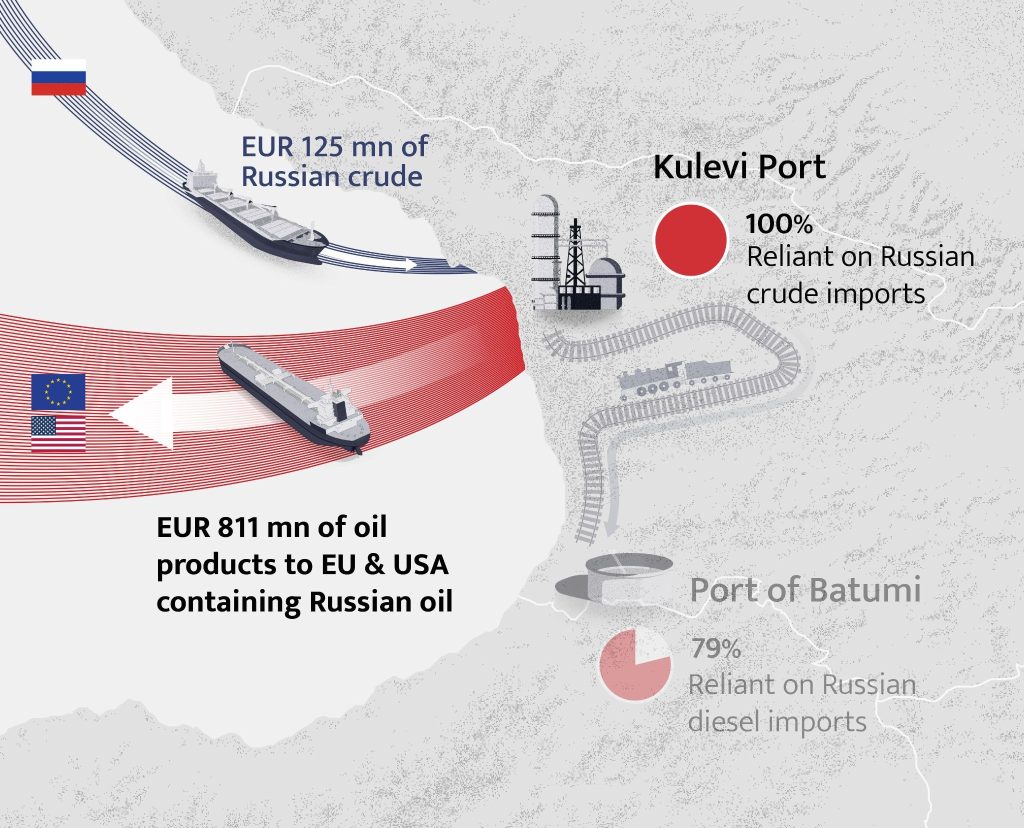
The most important shift came in October 2025, when the tanker KAYSER—now known as ALTURA—arrived at Kulevi carrying 100,000 tons of Russian crude oil.
The cargo was delivered to the newly opened Kulevi refinery, owned by LLC “Black Sea Petroleum.”
The refinery began operating, and in November Georgia exported more than 60,000 tons of petroleum products classified as locally produced.
The volumes continued to rise. In some months, they doubled.
But the trade data presented a growing contradiction: the amount of crude oil officially entering Georgia was not sufficient to account for the volume of petroleum products leaving the country.
Until October 2025, large-scale Russian crude-oil imports into Georgia had not been officially recorded. There may have been smaller shipments, but they were not large enough to materially change the statistics.
The arrival of the “Kayser” tanker marked a turning point.
After that shipment, tanker traffic increased.
Some of the vessels were suspected of belonging to Russia’s so-called “shadow fleet,” a term used for vessels employed to move oil and other commodities in ways designed to obscure their origin, ownership or sanctions exposure.
The issue eventually attracted the attention of the European Commission.


On March 10, 2026, Georgia’s government and SOCAR, the owner of Kulevi port, committed to the European Commission that vessels belonging to the “shadow fleet” or vessels of suspicious origin would no longer be allowed into the port.
Russian oil-product traffic through Kulevi subsequently declined.
But the trade did not disappear. Some of it shifted toward Batumi.
What Does a Refinery Actually Produce?
To understand the discrepancy, it is necessary to start with the mechanics of refining.
Crude oil is a mixture of hydrocarbons rather than a single uniform substance. Refineries heat the crude and separate it into different fractions using distillation and other processing technologies.
The resulting products include gasoline and other light petroleum products, diesel, fuel oil and heavier fractions.
Georgia’s exported petroleum products are primarily recorded under two trade codes:
HS 271012 — light petroleum products.
HS 271019 — medium and heavy petroleum products.
The same crude-oil feedstock can produce both categories.
But there is a fundamental physical constraint: a refinery cannot simply create additional crude oil.
In broad terms, 100 tons of crude cannot produce more than 100 tons of petroleum products.
In fact, the final liquid yield is normally lower.
A modern, efficient refinery can produce substantial quantities of diesel, gasoline, aviation fuel and other products, but part of the crude becomes gas, coke, sulfur and other by-products. There are also technological losses.
Depending on the crude and the refinery’s technology, total liquid-product yields are typically around 85% to 95%.
That makes Georgia’s statistics particularly difficult to explain.
Kulevi is the country’s only full-cycle refinery with above-average technological capacity. Its exact efficiency certification was not available for this analysis.
Even so, the calculations were based on an optimistic assumption: that the refinery or refineries were operating at a very high efficiency and producing the maximum possible quantity of final products.
Even under that assumption, the numbers do not consistently reconcile.
The Gap Appears in December
For October 2025, the available crude-oil stock was sufficient to explain the petroleum products exported in November.
The problem becomes visible in December.
In December 2025 and January 2026, Georgia exported 207,011 tons of petroleum products as locally produced goods.
Producing that amount would have required approximately 243,542 to 295,730 tons of crude oil, depending on the assumed refinery yield.
At the time, approximately 201,488 tons of crude oil were available in the country. That figure combines previous stocks with crude received in January.
The gap is therefore substantial.
February looks different.
Georgia imported 85,612 tons of crude oil, while 68,259 tons of petroleum products under HS 271019 were exported as locally produced.
In this case, the incoming crude was sufficient to explain the exports, with approximately 13,000 tons remaining for the following month.
March creates another discrepancy.
Official data show roughly 147,000 tons of petroleum products exported as local production.
At an optimistic 85% yield, producing that amount would require about 173,000 tons of crude oil.
Yet by March 27, Georgia had a maximum of approximately 98,000 tons of crude available.
April presents an even larger problem.
Official data show no crude-oil imports into Georgia during the month.
At the same time, the country exported 121,421 tons of petroleum products.
Producing that volume would have required roughly 143,000 tons of crude oil.
Even if the crude that arrived on March 27 had been processed almost entirely for April exports, the available supply would still not be enough to explain the reported volume.
The statistics, in other words, describe a supply chain that appears to contain more raw material than the official import records show.
Inside the Kulevi Refinery

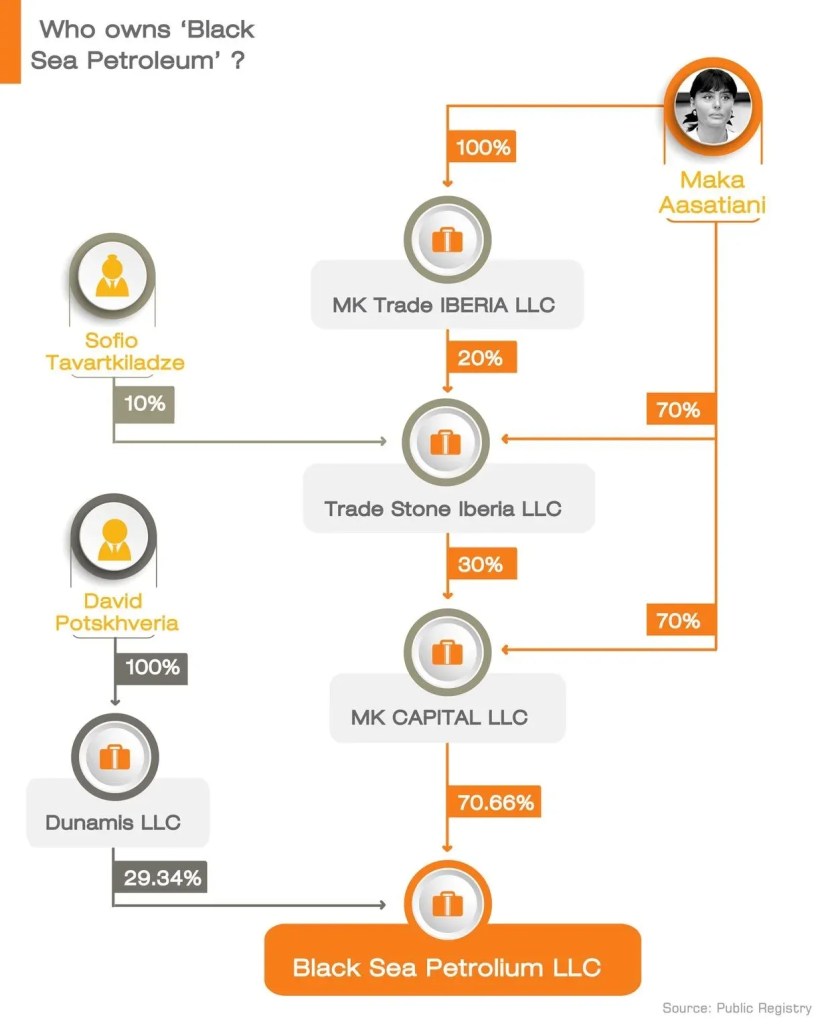
The Kulevi refinery sits on Georgia’s Black Sea coast and is owned by LLC “Black Sea Petroleum.”
The company has rights to use up to 200 hectares of land. The refinery itself occupies 60 hectares purchased from LLC “Phasis Oil” for a symbolic price of 1 lari.
“Phasis Oil” had previously planned to build a refinery on the site, but the project was abandoned.
The remaining area—up to 140 hectares—is state-owned and has been made available to “Black Sea Petroleum” for periods ranging from 5 to 49 years. Some of the land belongs to the forest fund.
The refinery is linked to Kulevi Port by a 20-kilometer pipeline, which the company says has been completed.
It does not yet have a railway connection. A separate railway infrastructure project is planned.
For now, crude oil arrives through the SOCAR-owned oil terminal and port infrastructure, while petroleum products are shipped out through the same system.
Questions were sent to the Kulevi refinery on May 25, asking how much crude had been processed since operations began, where the resulting products had been sold and how fully the refinery was operating.
Management did not respond.
That left publicly available records as the primary source for assessing the refinery’s activity.

A Rapidly Growing Balance Sheet
The financial statements of LLC “Black Sea Petroleum” provide another indication of how quickly the business expanded.
Between 2022 and 2024, the company’s assets rose from 68,000 lari to 184 million lari.
Long-term liabilities increased from 71,000 lari to 42 million lari.
Employee compensation also rose sharply. In 2023, the company spent 622,000 lari on employee remuneration. In 2024, that figure reached 2.4 million lari.
Yet the company reported a loss for 2024. By the end of the year, the loss exceeded 19 million lari.
Financial data for 2025 were not yet publicly available.
At the beginning of March 2026, television channel “Imedi” reported that the refinery was already operating at a nominal capacity of at least 1 million tons.
A similar claim appeared later in March in a BM.ge report.
The timing was notable because the claims came as the possibility of sanctions against Kulevi Port was being discussed.
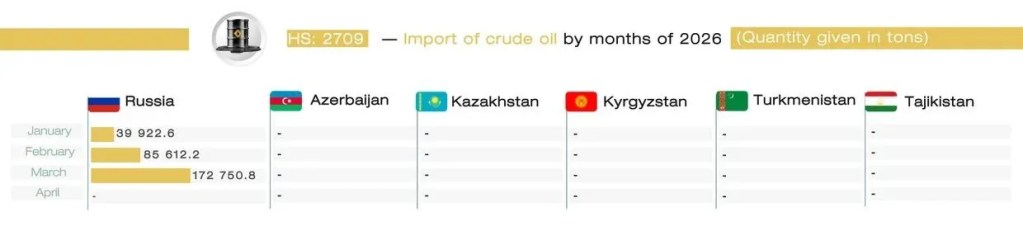
David Potskhveria, the refinery’s director, said the company planned to replace Russian crude with oil from Central Asia.
A February 26 article commissioned for Georgia Today said the refinery had previously used Azerbaijani and Russian crude but was moving toward diversification, including Turkmen crude in March-April and Kazakh crude in the near future.
The stated objective was to expand access to the European market and improve both geopolitical security and commercial returns.
A March 29 BM.ge interview with David Potskhveria repeated the same position.
The import statistics, however, tell a different story.
In March and April, there was no corresponding increase in crude imports from Central Asia.
There was, however, continued Russian crude.
That raises another question: if the refinery was still primarily processing Russian crude, how quickly could it realistically enter the European market?

Where Are the Products Going?
“Black Sea Petroleum” did not respond to a formal request for data on the volume of crude processed and petroleum products sold between October 2025 and May 2026, including the countries receiving those products.
Geostat was also asked for exporter data, but the information provided was incomplete.
By reconciling available databases with responses to dozens of information requests, it was possible to establish that “Black Sea Petroleum” exports petroleum products to at least Togo, the United Arab Emirates, Singapore, Turkey, Gibraltar and Malta.
The most concrete figures are available for Togo and Singapore.
During the first four months of 2026, Georgia exported 105,384 tons of petroleum products to Togo, worth more than $96.8 million.
Singapore received 37,932 tons, valued at $11.8 million.
These were the first instances of petroleum-product trade between Georgia and those two destinations. Before “Black Sea Petroleum,” no Georgian company had supplied petroleum products to either country, making the company the sole Georgian supplier in these flows.
The geographic footprint expanded elsewhere as well.
Following the rise in reported domestic production, Georgian petroleum products began appearing in Libya, Gibraltar, Algeria, Morocco and China.
Exports to Turkey and the United Arab Emirates also accelerated.
Turkey provides one of the clearest examples.
Until 2024, Georgia had never exported more than 1,100 tons of locally produced petroleum products to Turkey.
In 2024, exports rose to 5,000 tons.
In 2025, they reached 31,765 tons.
During the first four months of 2026, Georgia exported 130,941 tons to Turkey—122 times the amount recorded in 2021.
The United Arab Emirates shows a similar pattern.
Georgia began exporting locally produced petroleum products there in small quantities in 2016. The previous peak came in 2023, at 8,116 tons.
In 2025, exports reached 46,140 tons, roughly six times higher.
In just the first four months of 2026, another 34,816 tons were exported.
From Kulevi to Batumi
The available trade records suggest that Kulevi and Batumi are both being used to move products associated with the Kulevi refinery.
Between October 2025 and April 2026, Kulevi Port handled an average of 65% of Georgia’s petroleum-product exports.
By April and May, however, its share had fallen to roughly 29%-23%, while Batumi’s role increased.
International shipping databases show vessels carrying “Black Sea Petroleum” products to Singapore being loaded in both Batumi and Kulevi.
Because the company is the only identified Georgian exporter of petroleum products to Singapore, the shipments provide a useful illustration of how the two ports may be linked in the trade chain.
The logistical challenge is greater for Batumi than for Kulevi.
The refinery is connected directly to Kulevi Port by pipeline. Batumi does not have the same direct connection.
Under ordinary procedures, without document manipulation, petroleum products could theoretically be transported from the refinery by pipeline to the Kulevi oil terminal, loaded onto railway wagons, transported to Samtredia and then sent onward to Batumi.
That would provide a physical route between the refinery and Batumi.
Three Possible Explanations
The central question remains: how can Georgia export more petroleum products than the amount of crude oil officially available to produce them?
Georgia’s oil trade has been under scrutiny since at least the end of 2023, and previous investigations have documented Russian oil-trading structures operating through the country.
To test the numbers independently, an analyst with international oil-market expertise was contacted.
Robert Auers, an analyst of processed petroleum products at the American energy analytics and consulting company RBN Energy, reviewed the Georgian figures.
His assessment was blunt: something in the reporting appears incomplete.
He said there was no obvious mechanism by which the country could produce more physical product than the amount of raw material entering the system.
That leaves several possible explanations.
None has been publicly proven.
The first possibility is that some finished petroleum products imported for domestic consumption are subsequently exported without being materially processed, while being classified as locally produced.
If so, the issue would extend beyond a statistical discrepancy.
It could also raise sanctions concerns because the certificate of origin would potentially identify Georgia as the country of origin even when the underlying product was Russian.
Three indicators make this scenario worth examining.
First, imports of finished petroleum products from Russia increased by 13.4% compared with the previous year.
Second, Georgia’s re-export figures fell by approximately 60% after locally produced petroleum exports began rising.
Third, there are precedents in which Russian petroleum products entered European markets through Georgia with Georgia identified as the country of origin.
A second possibility is blending.
Imported petroleum products could be combined with locally processed products before being exported.
Blending petroleum products of different origins or characteristics is a common practice in international oil markets. The resulting product can have different physical characteristics and may be recorded under a different trade code.
The possibility is particularly relevant because previous investigations found that oil terminals can store petroleum products from different countries with the same characteristics in a single reservoir.
Under international sanctions rules, however, blending does not automatically erase the origin of the underlying product.
A third possibility is incomplete reporting of crude imports.
In this scenario, more crude oil may be entering Georgia than official statistics show.
That would resolve the physical imbalance, but it raises another question: why would additional crude imports of tens of thousands of tons go unreported?
The Missing Answer
There is no publicly available evidence that conclusively establishes which of these explanations is correct.
What is clear is that the official numbers do not comfortably fit together.
Between October 2025 and April 2026, Georgia imported 525,160 tons of crude oil while exporting 604,932 tons of petroleum products classified as locally produced or processed.


The difference is 79,772 tons.
Georgia’s entire annual domestic crude-oil production averages only about 40,000 tons.
The discrepancy is therefore too large to be dismissed simply as domestic production.
The Kulevi refinery, the sharp increase in locally classified exports, the decline in re-exports, the continued arrival of Russian crude and the expansion of new export destinations all form part of the same rapidly changing trade picture.
The key question is not whether Georgia can refine crude oil. It clearly can.
The question is whether the publicly reported quantities of crude entering the country are sufficient to account for the petroleum products leaving it.
So far, the authorities have not provided an explanation that closes that gap.
The Revenue Service was asked which of the scenarios described above it considered most plausible and, if none were correct, how it explained the statistical discrepancy.
A meeting with a competent official was also requested.
Neither request produced an answer.
As of the latest available information, there is still no official explanation for how Georgia’s petroleum exports grew beyond what its reported crude-oil supply would physically allow.



















One response to “Georgia’s Oil Surge Is Built on Russian Crude—and a $96.8 Million Question”
[…] Georgia’s Oil Surge Is Built on Russian Crude—and a $96.8 Million Question […]